
How Often Should You Post on YouTube? The Real Answer by Channel Size
There is no universal number of videos per week. The right cadence is the fastest rhythm a creator can sustain without the quality dropping — usually one video a week for new channels, moving higher only once production is systemized. Consistency over months matters more than raw frequency in any single week.
If you are asking how often should I post on YouTube, you have probably already been told the answer: every day. Post daily, the advice goes, and the channel takes off. It is the most repeated piece of guidance on the platform, and for most creators it is the fastest route to quitting.
The useful answer depends on where your channel is, what format you make, and — more than anything — what you can hold for six months without dreading it. This post breaks cadence down by stage, explains what upload frequency does and does not do, and gives you a way to pick a schedule you will still be running next year.
Why "Post Every Day" Breaks New Creators
Daily posting advice usually comes from creators for whom it worked — which is a selection problem, not evidence. You do not hear from the far larger group who tried it, burned out in five weeks, and stopped.
The mechanics are simple. Every upload costs you idea, script, filming, editing, thumbnail, and metadata. Early on, none of those steps are fast yet, because you have not built the habits or the templates. Multiply an unoptimised process by seven and the arithmetic breaks. What follows is predictable: quality drops to protect the schedule, results get worse rather than better, and the creator concludes they are not cut out for it — when the real problem was a cadence chosen for someone else's production system.
The framing that actually helps: your upload frequency is an output of your production capacity, not an input you choose first. Increase the capacity — through templates, batching, and a repeatable format — and the frequency can rise without the quality falling. Raise the frequency first and something has to give, and it is always the video.
Does Posting More Often Help the YouTube Algorithm?
Not directly, and this is worth being precise about because the internet is confident in both directions. YouTube's recommendation systems work at the level of individual videos and individual viewers: they are predicting whether a particular person is likely to watch and enjoy a particular video. YouTube publishes no upload-frequency requirement, describes no ranking bonus for posting daily, and documents no penalty for gaps between uploads.
So the confident claims you will see — that the algorithm rewards predictable schedules, or that it punishes you for going quiet — are folklore rather than documentation. Posting more often does not make each video perform better. It gives you more videos, each of which is judged on its own.
That does not make consistency pointless. It relocates the benefit to where it actually lives, which is with your audience and with you:
- Audience habit. People who like your work start expecting it. A rhythm they can anticipate is what turns a one-time viewer into a returning one — and returning viewers are the foundation everything else is built on.
- Your own learning rate. Every upload is a test. Two videos a year gives you two data points; two a month gives you twenty-four. Frequency mostly buys you feedback, and feedback is what makes video fifty better than video five.
- More chances to be found. More videos means more topics in the library, and any one of them can find an audience later. That is a volume effect, not an algorithmic reward.
For how recommendations actually get made, see How the YouTube Algorithm Works — this post stays on cadence.
How Often Should I Post on YouTube as a Beginner?
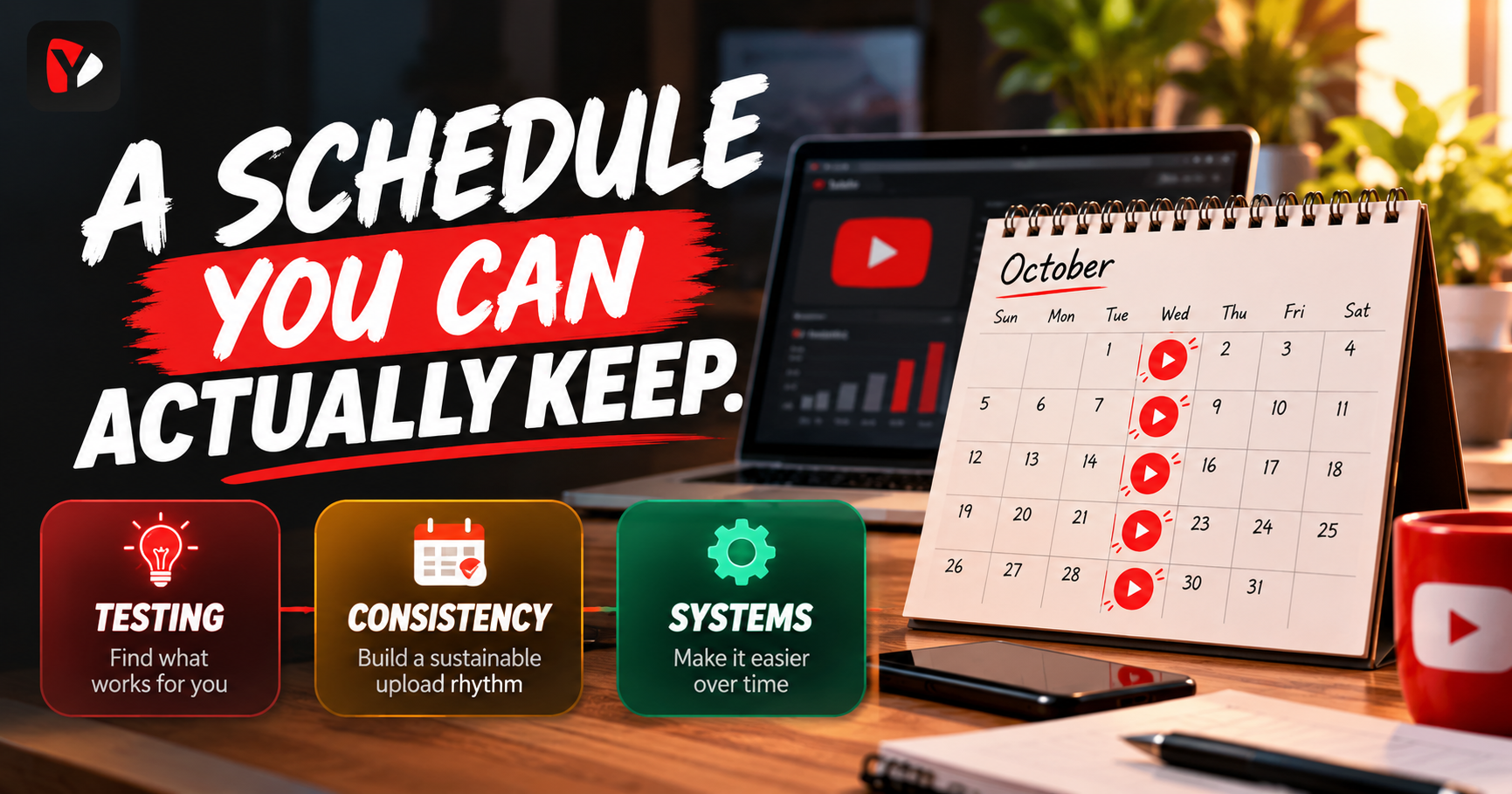
One video a week is a realistic starting point for most new creators, and two Shorts a week is a reasonable alternative if short-form is your format. The number matters less than the reason behind it, which changes as the channel changes.
| Stage | What cadence is for | A workable starting rhythm |
|---|---|---|
| Testing — new channel, still finding the format | Learning. Each upload is a data point about what your audience responds to. | One video a week, or two Shorts a week — enough to gather signal without exhausting you before you have found your footing. |
| Consistency — some traction, a format that works | Habit. Returning viewers start expecting you, which is what turns a viewer into an audience. | The same one or two videos a week, on days you can actually hold for three months straight. |
| Systems — a repeatable format and a production routine | Throughput. Batching and templates let you add volume without adding hours per video. | Increase only where the system supports it — often more Shorts rather than more long-form. |
The testing stage: cadence buys you information
In the first months, you do not yet know what your audience responds to, what your format should be, or how long a video should run. Uploads are experiments. The goal is enough of them to learn from, at a quality level you are not ashamed of — which for most people means weekly, not daily. Resist adding volume here; add attention instead. A weekly video you thought hard about teaches you more than seven you rushed.
The consistency stage: cadence builds the habit
Once something is working, the job changes. Now the rhythm itself has value, because returning viewers begin to expect you. Pick a schedule you can keep during a bad week, not a good one — the test is whether you could still hit it while ill, travelling, or busy at work. If the honest answer is no, the schedule is too aggressive, and one missed week does more damage to your own momentum than a slower pace ever would.
The systems stage: cadence follows capacity
With a repeatable format and a production routine, you can raise output without raising hours per video — batching scripts, reusing thumbnail templates, filming several videos in one session. This is the only stage where increasing frequency is straightforwardly sensible, because the system absorbs it. Even here, most creators get more from adding Shorts than from adding long-form, since the production cost per Short is far lower.
Long-Form and Shorts Are Two Different Cadences
Treating them as one schedule is a common mistake. A long-form video carries a heavy production cost and is discovered largely through search and suggested placements, so it rewards depth and can keep earning attention for months. A Short costs a fraction of the effort, is discovered through the feed, and has a much shorter useful life.
The practical consequence: sustainable Shorts cadences are naturally higher than sustainable long-form cadences, and the two can run in parallel — one long-form video a week plus several Shorts is a common, workable pattern, and it is far easier to sustain than three long-form videos. The Shorts-specific rhythm and what drives Shorts discovery are covered in the YouTube Shorts Growth Guide.
How to Build a Schedule You Can Actually Keep
The trick is to stop producing videos one at a time. Doing the same task once for four videos is dramatically faster than doing four different tasks four times, because you are not paying the switching cost each round.
1. Batch the ideas. One planning session, four topics chosen. Deciding what to make is the step most likely to stall a week, so getting it done in advance removes the most common failure point.
2. Batch the writing. Draft the outlines or scripts for all four in one sitting while you are in writing mode. The Script Builder can produce first drafts to react to, which is usually faster than starting from an empty page.
3. Batch the filming. Set up once, shoot several. Lighting and setup are fixed costs you would otherwise pay four separate times.
4. Batch the packaging. Titles, descriptions, and tags for all four in one pass — the Content Generator drafts the metadata set so this stops being the tired task you do at midnight.
5. Schedule, then forget. Queue the uploads so a busy week cannot break the rhythm. This single step is what converts a good intention into an actual schedule.
Done this way, a month of weekly videos takes one heavy weekend rather than four anxious ones — and the schedule survives the weeks when life interferes, which is the only real test of a cadence.
Are You Posting Too Often, or Not Often Enough?
Judge this from your own channel rather than from anyone's rule. Two honest sets of symptoms:
Signs your cadence is too high:
- Your average view duration is drifting down across recent uploads — usually the first thing to go when videos are rushed.
- You are shipping videos you would not have published three months ago.
- Each new upload gets noticeably less attention than the last, and nothing else changed.
- You dread the schedule. This one is not soft — resentment shows up in the videos, and it is the strongest predictor of quitting.
Signs your cadence is too low:
- Returning-viewer numbers are thin: people watch once and never come back, because nothing tells them there is more coming.
- You cannot tell what is working, because your uploads are too far apart to compare fairly — conditions change between them.
- Months pass between videos and each one starts cold, with no accumulated momentum from the last.
Notice that none of these are algorithm symptoms. They are audience symptoms and learning symptoms, which is exactly where cadence has its real effect.
Can You Change Your Upload Schedule Later?
Yes, and you almost certainly will. Creators treat their cadence as a promise they cannot break, which is why so many hold on to a schedule that is quietly ruining the work. Nothing documented happens when you change it.
Two practical notes. Slowing down works best when you say so — a single line in a video or a community post telling people the new rhythm keeps the expectation intact instead of leaving them to notice you disappeared. And speeding up works best when you have already proven the new pace privately: film four weeks of the higher cadence before you announce it, so you find out whether the system holds before your audience is depending on it.
The schedule serves the channel. When it stops doing that, change it.
Cadence and Timing Are Two Different Levers
Everything above is about how many videos you publish. When in the day you publish them is a separate question with a separate answer, and the two get conflated constantly.
Cadence is a production decision you make once and hold for months. Timing is a per-upload decision based on when your particular audience is online, which varies by channel and by region. Once you have chosen a rhythm you can keep, use Best Time to Post to work out the second one for your channel — it is the natural next step after this decision, not a substitute for it.
The Bottom Line
There is no number that works for everyone, and the creators who last are rarely the ones posting most. Pick the fastest rhythm you can hold on a bad week, keep it for three months, and let your production system — not your ambition — decide when it goes up. One good video a week, sustained for a year, puts fifty videos in your library. Seven a week, sustained for a month, puts twenty-eight and then stops.
Plan your next batch of uploads, then check the best time to post each one. Both work from a phone as well as the web, so a planning session does not need a desk.