
YouTube Growth Hacks That Actually Work in 2026
If you are searching for YouTube growth hacks 2026, you have probably already tried the recycled advice that fills most blogs - post consistently, engage with comments, use trending tags. None of that moves the needle anymore. The platform has changed, the algorithm reads new signals, and the creators pulling ahead this year are doing things that look almost nothing like the 2022 playbook.
This guide skips the filler and walks through seven tactics that genuinely move impressions, watch time, and subscribers in 2026 - with examples small creators can use on their very next upload, and a section on what monetized channels should be doing differently to scale beyond the plateau.
Quick Answer
The YouTube growth hacks that actually work in 2026 focus on signal quality, not volume: optimize your first 30 seconds for retention, engineer your thumbnail and title for click-through rate above 6%, target rising-search topics before they peak, and publish during your audience's exact peak window. Tools that score these signals before you upload - like YouSEO - let creators ship better videos faster instead of guessing.
Why Do Most YouTube Growth Hacks Stop Working After a Few Uploads?
Most YouTube growth hacks stop working because they target tactics, not signals. The algorithm has gradually shifted from rewarding surface-level activity - keywords, tags, hashtags - to rewarding viewer behavior signals like average view duration, session watch time, and click-through rate on the impression feed. A hack that pumps tag density does nothing if your retention curve still drops at the 30-second mark.
The tactics in this guide are different. Each one targets a specific signal the 2026 algorithm actually weighs, and each one is something you can verify on your own analytics inside one or two upload cycles.
How Important Is the First 30 Seconds for YouTube Growth in 2026?
The first 30 seconds is the single most important window in your video. If average view duration drops below 70 percent in that opening, the algorithm reads it as a satisfaction failure and buries the upload. Most creators lose viewers here because they open like a blog post - greeting the audience, previewing the structure - instead of delivering a pattern interrupt. What works in 2026 is opening with a concrete promise and planting an open loop the viewer needs to stay for. Skip the introduction. Make the first sentence the most interesting one in the entire video.
What Click-Through Rate Should You Target on YouTube in 2026?
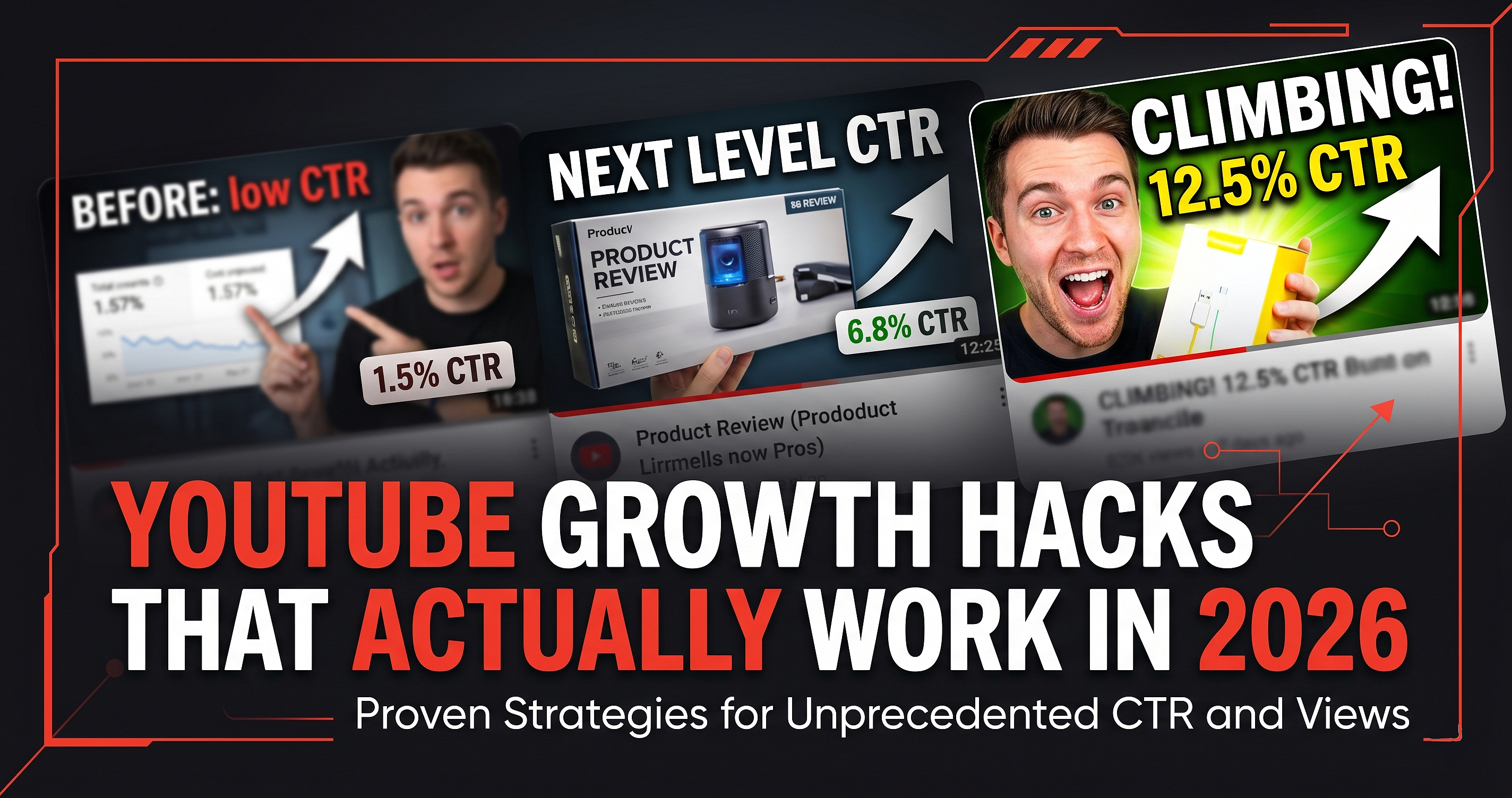
Aim for 6 percent or higher on every upload. The platform median sits between 4 and 5 percent depending on niche, and channels that consistently beat it get progressively wider distribution on each upload. CTR is not just a video-level signal - it is a channel-level signal, which means a string of low-CTR videos can cap your reach for months.
Two things move CTR fast. First, write titles around curiosity gaps and specificity - vague titles die in the impression feed. Second, score your thumbnail before you publish instead of after. Tools like the YouSEO Thumbnail Click Score analyze your design against thousands of high-performing thumbnails in your niche and tell you, in seconds, whether it will out-perform the channels you are competing against.
How Do You Find YouTube Topics Before They Peak?
Track search velocity, not search volume. Most keyword tools rank topics by absolute monthly volume - but by the time a topic appears at the top of those lists, the search demand has already saturated and the top results are locked in. The window where small channels can actually win is two to four weeks before that peak, when search counts are rising fast but the SERP is still thin.
Run your topic ideas through a velocity-aware tool like the YouSEO Trending Video Ideas tool before you film. It surfaces topics where searches are growing week over week, in your specific niche, with low competition. That is the gap small creators can ride into recommended traffic - and it closes the moment a topic becomes obvious.
Does Niche Consistency Still Matter for YouTube Growth?
Niche consistency matters more in 2026 than it ever has. The algorithm assigns every channel an invisible topical authority score. Channels that upload around a single niche, with strong watch-time signals, get promoted on every related search and suggestion. Channels that drift across topics - one gaming video, one vlog, one cooking tutorial - never accumulate that authority and stay stuck in the impression-starved zone.
If your channel has been live six months without traction, audit your last twenty uploads. If they cover more than two distinct topics, the issue is your channel signal - not content quality. Pick one lane and stay in it for the next twelve uploads.
Does Upload Time Affect YouTube Growth in 2026?
Upload timing matters per channel, not per generic rule. Forget the old advice about Tuesday at 3 PM - what matters is when your specific subscribers are logged in and scrolling. YouTube tests every new upload on subscribers first; if they do not engage in the first hour, the video gets shelved before it ever reaches a wider audience. Small channels cannot afford that dead window.
Pull your audience activity heatmap from YouTube Studio and publish in the densest 30-minute block. Pair that with same-day submission to Google Search Console for faster indexing across regular search and AI search engines like ChatGPT, Perplexity, and Gemini. Early-window momentum is what tips a video into the recommended sidebar - and recommended traffic still drives roughly 70 percent of view growth.
What Should Beginners and Monetized Creators Focus On Differently?
Growth Hacks for Beginner Creators (under 1,000 subscribers)
Beginners should obsess over signal quality on every single upload. With a tiny subscriber base, you cannot afford one weak video - every upload is a fresh test of channel-level CTR and retention. Focus on these three priorities:
- One niche, twelve uploads. Build topical authority before you experiment with format.
- Score every thumbnail before publish. Aim to beat the niche median CTR by 1.5×.
- Pre-publish keyword research, not retrofitting. Confirm search demand before you film, not after.
Growth Hacks for Monetized Creators (looking to scale beyond the plateau)
Monetized creators have a different problem. The early growth curve has flattened, RPMs have stabilized, and the next leap requires breaking out of the niche cluster the algorithm has boxed you into. Three priorities here:
- Adjacent-niche bridging. Run two or three test videos in a related niche to widen your topical surface before going all-in.
- Hook A/B testing at scale. Use the Viral Hook Writer to generate eight to twelve hook variants per video, ship the strongest, and track 30-second retention shifts.
- Description optimization for AI search. Open every description with the question your video answers, in plain language. AI engines quote that opening line back to viewers searching adjacent queries.
Putting These YouTube Growth Hacks Into Action
The pattern across every tactic in this guide is the same: stop sending weak signals to the algorithm and start scoring each signal before publish. Hooks tuned for retention. Thumbnails tuned for CTR. Topics tuned for rising demand. None of these are individually revolutionary - but together, on every upload, they compound into the growth curve most creators chase for years and never quite catch.
The free tier of YouSEO unlocks the Keyword Generator, Title Generator, and Trending Video Ideas. Try YouSEO free today, run your next video through the pipeline, and see how the impression feed responds in the first 24 hours.