
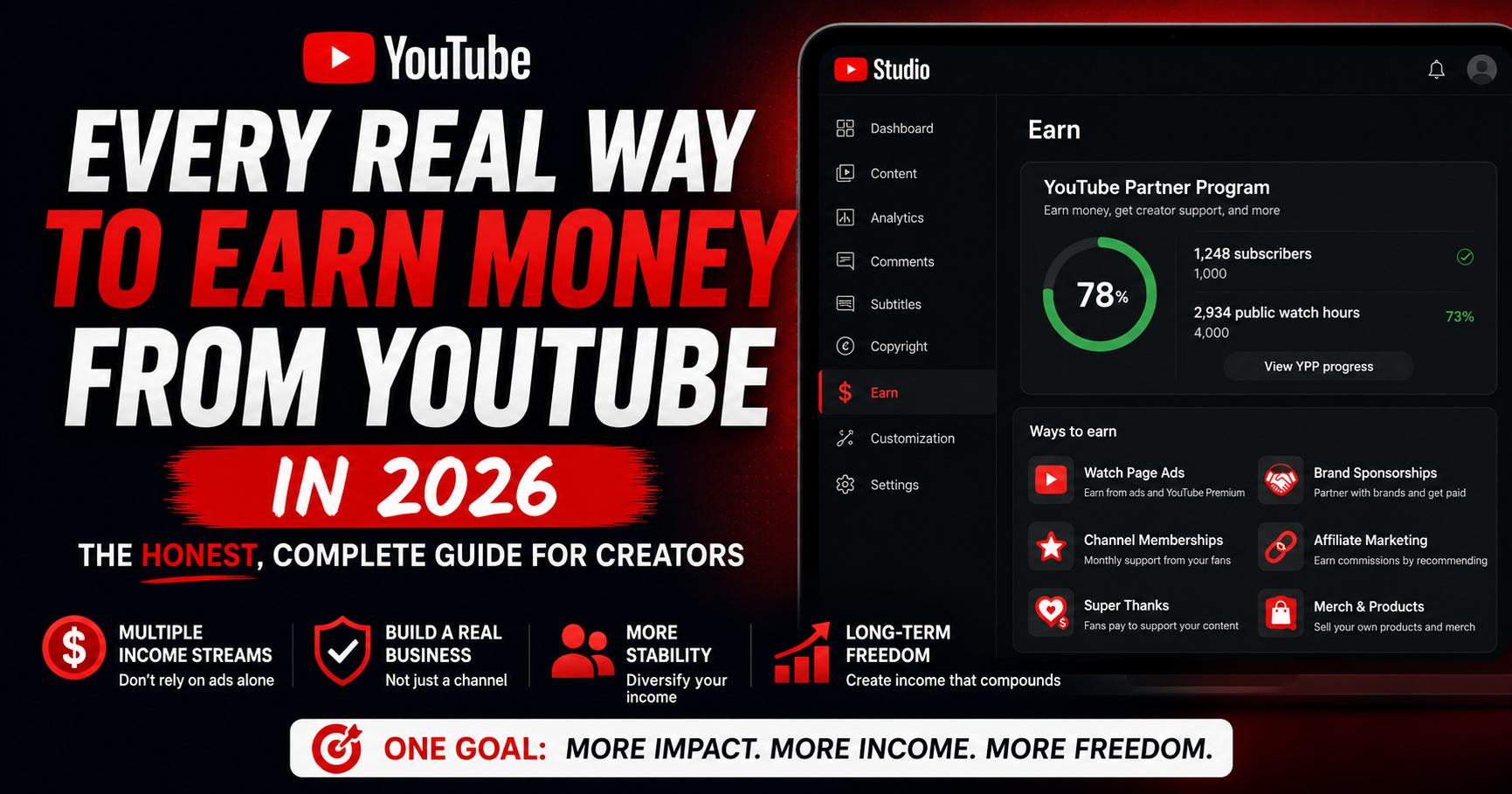
How to Earn Money from YouTube: Every Way Creators Actually Get Paid
If you're wondering how to earn money from YouTube, here's the honest truth up front: there are many real, legitimate ways creators get paid - but nearly all of them depend on first building an audience. YouTube isn't a lottery ticket. It's a platform where consistent, original content earns views, views build a following, and a following unlocks income streams you can stack over time.
This guide covers every genuine earning method - from ad revenue and memberships to sponsorships, affiliates, and your own products - with realistic expectations for each. No get-rich-quick promises, no inflated numbers. Just an accurate, complete picture of how YouTube income actually works in 2026, including a dedicated section for creators in India and other lower-ad-rate markets.
Quick Answer
You earn money on YouTube mainly by joining the YouTube Partner Program - 500 subscribers unlocks early fan-funding features, and 1,000 subscribers plus 4,000 watch hours (or 10M Shorts views) unlocks ad revenue. From there you stack income: ads, memberships, Super Thanks, YouTube Shopping, sponsorships, affiliates, and your own products. Ad rates vary hugely by niche and country.
Can You Actually Make Money on YouTube?
Yes - but it takes an audience and time, and most channels earn little at first. The creators earning full-time incomes almost always do two things: they built a genuine, engaged audience over months or years, and they diversify across several income streams rather than relying on any single one. Ad revenue alone is rarely enough, especially outside high-ad-rate countries.
So treat this as a realistic roadmap, not a shortcut. The earning methods below are all real, but they reward patience and consistency. If you're just starting, your first job isn't monetization - it's making content good enough to grow the audience that monetization depends on.
First, the Gate: the YouTube Partner Program
Most YouTube earning runs through the YouTube Partner Program (YPP), and in 2026 it has two tiers. You don't need a huge channel to start - the first tier opens early - but the tier that includes ad revenue has a higher bar. You only need to meet ONE path per tier, and you can qualify with either long-form video or Shorts.
| Tier 1 - Early Access | Tier 2 - Full Monetization | |
|---|---|---|
| Subscribers | 500 | 1,000 |
| Plus one of | 3,000 watch hours (12 mo) OR 3M Shorts views (90 days) - plus 3 public uploads in 90 days | 4,000 watch hours (12 mo) OR 10M Shorts views (90 days) |
| Unlocks | Fan funding (Memberships, Super Thanks, Super Chat, Super Stickers, Jewels) + Shopping | Everything in Tier 1 PLUS ad revenue + YouTube Premium share |
| Ad revenue? | No | Yes |
A crucial nuance: watch time from Shorts in the Shorts Feed does NOT count toward the 4,000-hour long-form threshold - the 10-million-Shorts-views path is the separate Shorts route. Beyond the numbers, every tier also requires that you follow YouTube's channel monetization policies, live in a country where YPP is available, have no active Community Guidelines strikes, turn on 2-Step Verification, have advanced features access, and link an AdSense for YouTube account (that's how you actually get paid).
You must apply - channels aren't auto-enrolled. Go to YouTube Studio → Earn, accept the terms, and link AdSense; review typically takes about a month. One more rule worth knowing: YouTube may turn off monetization on channels that haven't uploaded or posted for six months or more, so staying active matters.
A note on original content: YouTube requires original, advertiser-friendly content to monetize. Its crackdown on 'inauthentic content' (the rule formerly called 'repetitious content') means mass-produced, low-effort, reused, or undisclosed low-effort AI-generated content won't be monetized. Make something genuinely yours.
Way 1 - Ad Revenue
Ad revenue is what most people picture, and it unlocks at Tier 2. YouTube serves ads on your videos and shares the revenue: on monetized long-form videos, creators receive 55% of ad revenue (YouTube keeps 45%); on monetized Shorts, creators receive 45% of the eligible ad revenue from the Shorts pool after music licensing and other costs. You're also paid a share of YouTube Premium revenue based on how much Premium members watch your content.
The number that matters is RPM - revenue per 1,000 views. Long-form creators typically see roughly $2 to $10 RPM, though it swings enormously. Here's what that range means in practice:
| Views | At $2 RPM (low) | At $8 RPM (high) |
|---|---|---|
| 10,000 | ~$20 | ~$80 |
| 100,000 | ~$200 | ~$800 |
| 1,000,000 | ~$2,000 | ~$8,000 |
So earning $1,000 from ads alone can take anywhere from about 100,000 to 500,000 views, depending on your RPM. Why does RPM vary so much? Niche is the biggest factor - finance, business, and tech command far higher ad rates than entertainment or vlogs, because advertisers pay more to reach those audiences. Audience country matters too (the US, UK, Canada, and Australia are high; India, Nigeria, and Pakistan are much lower), along with season (Q4 is highest as advertisers spend for the holidays), your watch time, and which ad formats run. The honest takeaway: ads are a real income stream, but rarely enough on their own.
Way 2 - Channel Memberships
Channel Memberships let viewers pay a recurring monthly fee to support you in exchange for perks - custom badges, emoji, members-only videos, posts, or live streams. Available from Tier 1 (500 subscribers), memberships turn your most loyal fans into predictable monthly income. Even a small percentage of an engaged audience subscribing at a few dollars a month adds up to steady, recurring revenue that doesn't depend on ad rates at all.
Way 3 - Super Thanks, Super Chat & Super Stickers
These are tipping features, also available from Tier 1. Super Thanks lets viewers tip on your regular videos to show appreciation. Super Chat and Super Stickers let fans pay to highlight their message or send an animated sticker during live streams. YouTube has also added Jewels and gifts, which let fans purchase Jewels to send gifts during vertical and horizontal live streams. None of these will replace a salary on their own, but for creators who stream or post regularly, they're a genuine, direct way for your audience to support you in the moment.
Way 4 - YouTube Shopping & Merch
YouTube Shopping, available from Tier 1, lets you connect a merch store and showcase products on a shelf below your videos, or tag products directly in your content. You can sell your own branded merchandise or, depending on eligibility, tag affiliate products and earn on sales you drive. For creators with a real brand or a loyal community, merch turns audience affinity into product revenue - and unlike ads, you control the margins.
Way 5 - Brand Deals & Sponsorships
Sponsorships are often the single biggest earner for mid-sized and large creators - and they don't require YPP at all, since brands pay you directly. A company pays you to feature or mention their product, usually as a sponsored segment in your video. Rates depend on your audience size, niche, and engagement, but a single brand deal can dwarf a month of ad revenue. Brands care most about a relevant, engaged audience, so a focused channel with 20,000 loyal viewers in a specific niche can command strong deals. Creators land sponsorships by reaching out to brands they genuinely use, joining creator marketplaces, or being approached once their channel grows. This stream matters disproportionately in lower-ad-rate markets, where it often out-earns AdSense many times over.
Way 6 - Affiliate Marketing
Affiliate marketing means earning a commission when viewers buy through your links. You mention or review a product, drop your affiliate link in the description, and earn a percentage of any resulting sales. It works especially well for tutorials, reviews, and recommendation-style content where viewers are already in a buying mindset. There's no follower minimum and no YPP requirement - you can start affiliate marketing from your very first video, making it one of the most accessible early income streams. The key is only recommending products you actually trust; your audience's trust is the asset.
Way 7 - Selling Your Own Products, Services & Courses
This is usually the highest-margin path, because you keep almost all the revenue. Once you've built authority in a niche, you can sell your own digital products (courses, ebooks, templates, presets), services (consulting, coaching, freelancing), or physical products. Here, YouTube becomes a funnel: your videos demonstrate expertise and build trust, and a portion of viewers become customers. A creator teaching video editing can sell a course; a fitness creator can sell training plans; a design channel can sell templates. Because you own the product, there's no revenue split and no ad-rate ceiling - this is how many creators earn far more than their AdSense ever pays.
Way 8 - Off-Platform Fan Funding & Content Licensing
Beyond YouTube's own tools, many creators use off-platform fan funding like Patreon or Buy Me a Coffee, offering exclusive content or perks to paying supporters. This gives you a direct relationship with your audience and income that isn't tied to the algorithm. Separately, content licensing lets you earn when a viral video is licensed to media outlets or brands - if you capture something newsworthy, licensing agencies may pay to use it. And more broadly, YouTube can be a funnel to an entire business: consultants, freelancers, and founders use their channel to attract clients worth far more than any per-view rate.
How Much Can You Realistically Earn?
There's no single answer, because earnings depend on your niche, audience country, and - most of all - how many income streams you stack. Using the RPM table above, ad revenue for a channel getting 100,000 monthly views might be roughly $200 to $800 a month. That same channel could earn more from a single sponsorship, more again from memberships, and more still from its own product. That's why diversifying is the norm, not the exception, among full-time creators.
Shorts deserve an honest caveat: they pay far less than long-form. Shorts ad revenue lands on the order of a few cents per 1,000 views - rough estimates run between about $0.01 and $0.10 per 1,000 - so a Short with a million views might earn only around $30 to $100 from ads. Shorts are excellent for growth and reaching new viewers, but they're a weak direct earner. Use them to build the audience that your better-paying streams depend on.
The India Reality (and Other Lower-Ad-Rate Markets)
If your audience is mainly in India, this section matters most. Ad RPM in India is substantially lower than in the US for comparable niches, because advertiser CPMs are lower - the same video that earns $6 RPM from a US audience might earn a fraction of that from an Indian one. This isn't a reflection of your content; it's how the ad market works regionally.
The practical consequence: for Indian creators, ad revenue should be treated as a bonus, not the foundation. Many successful Indian creators earn far more from sponsorships, affiliate marketing, their own products and courses, and memberships than from AdSense. Brands in India pay well for relevant creator audiences, and digital products priced for the local market can scale. The good news is that India is on YouTube's expanded-YPP country list, so both tiers are available. But build your income plan around sponsorships, affiliates, and owned products first - with ad revenue as a welcome extra on top.
Earning Starts With Growth: How YouSEO Helps
Here's the honest thread running through this entire guide: every earning method requires an audience first. Ad revenue needs views and watch hours. Memberships and Super Thanks need fans. Sponsorships need a relevant, engaged following. You cannot monetize a channel nobody watches - so before income comes growth, and growth is exactly what YouSEO helps with. To be clear, YouSEO doesn't pay you or monetize your channel directly; it helps you build the views, subscribers, and watch hours your monetization depends on.
Start with YouTube keyword research to find topics people are actually searching for, so your videos get discovered instead of buried. Use the thumbnail maker to earn the click once you're in front of viewers, and the YouTube video SEO checker to fix what's quietly holding your videos back. When you need fresh, timely topics to grow faster toward the monetization thresholds, trending video ideas surfaces what's rising in your niche. For more on each, see check your YouTube video's SEO score, find trending YouTube video ideas, why your Shorts get no views, and best hashtags for YouTube Shorts.
Frequently Asked Questions
How many subscribers do you need to make money on YouTube?
You can unlock early fan-funding features (memberships, Super Thanks, Shopping) at 500 subscribers, provided you also have 3 public uploads in 90 days plus either 3,000 watch hours or 3M Shorts views. Ad revenue requires 1,000 subscribers plus 4,000 watch hours (or 10M Shorts views). You can also earn through sponsorships and affiliates with no subscriber minimum at all.
How much does YouTube pay per 1,000 views?
For long-form video, creators typically see roughly $2 to $10 RPM (revenue per 1,000 views), but it varies enormously by niche, audience country, and season. Shorts pay far less - on the order of a few cents per 1,000 views. These are estimates, not guarantees.
Can you earn money on YouTube without 1,000 subscribers?
Yes. Early fan-funding features open at 500 subscribers, and sponsorships, affiliate marketing, and selling your own products require no subscriber threshold or YPP membership at all - you can start those from your first video. Ad revenue specifically is what requires 1,000 subscribers.
Do YouTube Shorts make money?
Yes, but much less than long-form. Shorts earn a share of the Shorts ad pool - roughly a few cents per 1,000 views - so a million-view Short might make around $30 to $100 from ads. Shorts are best used for growth and reaching new viewers, which then supports your higher-earning income streams.
When does YouTube pay you?
YouTube pays through AdSense on a monthly cycle, once your balance passes the payout threshold (commonly cited as US $100 - verify the current figure), typically around the 21st of the following month. A linked AdSense account is required to receive any ad, membership, or other revenue.
The Bottom Line on Earning from YouTube
There are many real ways to earn money from YouTube - ad revenue, memberships, Super Thanks, Shopping, sponsorships, affiliates, and your own products - but they share one requirement: an audience. The creators who earn full-time incomes build a genuine following and stack several income streams rather than betting on ads alone. Pick two or three streams that fit your niche, and don't rely on ad revenue by itself, especially outside high-ad-rate countries.
And remember where it all starts. You can't earn without an audience - so grow the views, subscribers, and watch hours your monetization depends on. Use YouSEO's YouTube keyword research, thumbnail maker, video SEO checker, and trending video ideas to build the channel that makes every earning method possible. Download the YouSEO app or use the Web App to get started today.