
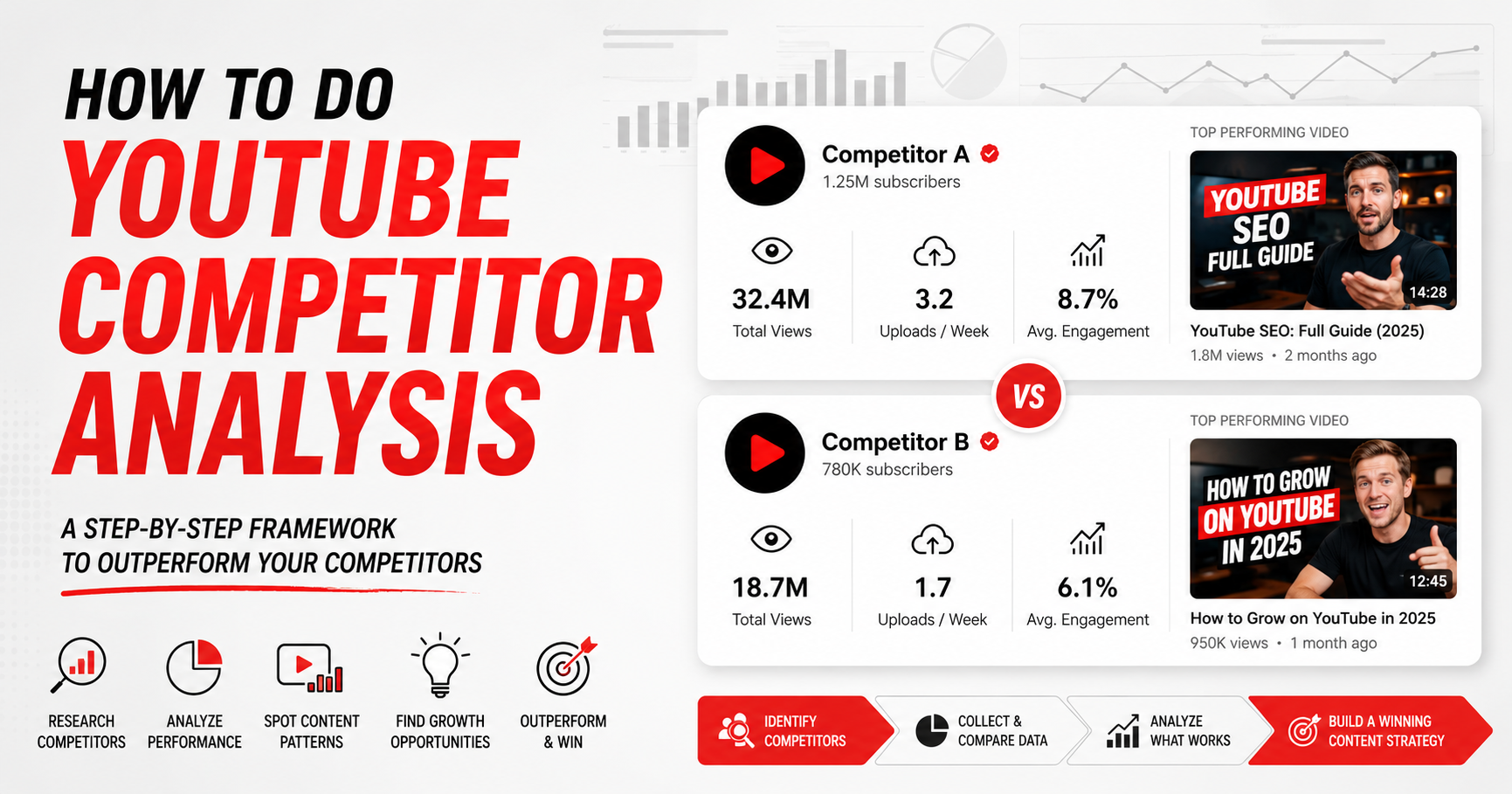
How to Study Your Competitors' YouTube Strategy (Without Guessing)
Most creators try to figure out how to analyze YouTube competitors by scrolling channels at random, picking the biggest names in the niche, or copying whatever they just saw go viral. None of that works reliably. Random guessing leaves you behind; copying tanks both your originality and your channel's authority signal.
Systematic competitor analysis is different. It's a repeatable process for identifying the channels actually chasing your audience, studying the specific patterns that drive their wins, and finding the gaps you can own. This guide walks you through that process step by step - inspiration, not imitation.
Quick Answer
To analyze YouTube competitors systematically, build a shortlist of 5-10 channels chasing your specific audience (not just the biggest names), sort their videos by popularity to find outliers, log patterns in a simple tracker - topics, titles, thumbnails, upload frequency, length, hooks, keywords, and playlist structure - then identify gaps and angles they're missing. Use the findings as inspiration, never to copy.
Why Does Systematic Competitor Analysis Beat Guesswork?
Guesswork relies on what feels interesting, which is biased toward what you personally already know. Systematic analysis reveals what your specific audience actually rewards - which is rarely the same thing. The creators who consistently grow over years aren't more creative than their peers; they're more analytical. They study which formats hit, which topics earn impressions, and which gaps competitors leave open. Then they execute differentiated content in those gaps. This is the difference between making content you hope works and making content you have evidence will work.
How Do You Identify Your Real YouTube Competitors?
Your real competitors aren't the biggest channels in your broad niche. They're the channels chasing the same audience, ranking for the same keywords, and earning the same kind of impressions you're competing for. A 50,000-subscriber gardening channel and a 5-million-subscriber gardening channel aren't competing for the same viewers in the same way.
Build a shortlist this way: search your top 5 target keywords on YouTube, note channels appearing in the top 10 results for at least two of them, and add the channels your YouTube homepage recommends alongside yours. The intersection is your real competitor set - usually 5-10 channels. Beyond that, you're studying signal noise.
What Should You Actually Study About Your Competitors?
Once you have your shortlist, study seven specific dimensions. Patterns emerge fastest when you compare across all five-to-ten channels.
1. Outlier and best-performing videos
Sort each competitor's videos by view count (highest first). Their top 5 outliers reveal what their audience truly responds to. Outliers - videos that significantly outperform a channel's median - point to a topic, format, or angle that struck a nerve. Focus 80% of your study time on outliers. The median uploads only tell you the baseline.
2. Topics, titles, and thumbnails that earn clicks
Look at the title-thumbnail combos of the top outliers. Are they emotional questions? Specific number claims? Surprising contrasts? Note recurring patterns. The packaging that wins repeatedly across multiple competitors is signal about audience psychology in your niche - not coincidence.
3. Upload frequency and schedule
Note each channel's posting cadence and the days/times their best videos went live. Patterns here reveal what audience expectations have been trained to - and what windows are saturated versus open in your niche.
4. Video length and format
Compare median video length across your competitors' top performers. If outliers cluster at 8-12 minutes, that's likely your niche's retention sweet spot. Note formats too: deep dives, tutorials, listicles, reactions - whichever format competitors win with consistently is the format winning with your shared audience.
5. Opening hooks and intros
Watch the first 30 seconds of each outlier. Does the channel cut intros entirely? Open with a question? Lead with the payoff? The hook patterns separating outliers from average videos are the strongest tactical lesson available.
6. The keywords they target
Look at competitor video titles and descriptions for repeated phrases. These are the keywords they're betting on. Run them through the YouSEO Keyword Research tool to see search volume, competition, and whether you can rank for the same terms or find adjacent ones competitors haven't claimed yet.
7. Playlist and series structure
Open competitor playlists. Channels with strong recurring series often have higher subscriber loyalty and longer session times. The playlist topics they invest in tell you which sub-niches they consider worth the long bet - useful intelligence for your own series planning.
What's the Step-by-Step Competitor Audit Workflow?
Run this 5-step audit in a simple spreadsheet - one row per competitor, one column per dimension:
1. Build your shortlist. Search your top 5 target keywords on YouTube. Note channels appearing in the top 10 for multiple queries. Aim for 5-10 channels.
2. Sort each channel's videos by popularity. Open each channel and click "Sort by popular." Note the top 5 outliers per channel.
3. Log patterns in your tracker. For each outlier, note the topic, title, thumbnail style, length, hook, and upload date. Look for repeated patterns across multiple channels' outliers.
4. Identify keyword overlap and gaps. Open the YouSEO Keyword Research tool and run the recurring topic terms through it. Find keywords with strong demand but limited competitor coverage - those are your gap opportunities.
5. Synthesize and act. Convert your findings into a content plan: 3-5 differentiated upload ideas that apply the patterns you found while filling a gap competitors miss. Schedule them over your next month.
How Do You Find Gaps and Angles Your Competitors Miss?
Gaps appear at the edges of your shortlist's coverage. Look for keywords with steady search demand but no competitor in the top 10 - your niche's blind spots. Look for outlier formats one channel won with but others haven't tried. Look for sub-niche audiences competitors mention briefly but don't serve directly. Each gap is a content opportunity where you can build authority faster because the SERP isn't crowded.
Once you've found a gap, the next step is generating differentiated ideas around it. Our companion guide on what should I make a YouTube video about covers seven methods for turning research insights into a steady idea pipeline - including how to expand one gap-topic into multiple angles.
How Should New and Established Creators Use Competitor Analysis Differently?
For new creators studying established channels
Beginners should focus on proven format discovery - what already works in the niche before they try to innovate. Pick 3-5 channels at the 50K-500K subscriber range (not millions - those have different signals). Study their first 20-30 uploads, not their current ones. Their early-channel patterns reveal what worked from zero, which is the stage you're currently at. Their current uploads are optimized for an audience they already have.
For established creators tracking direct rivals
Established channels should track 5-10 direct competitors month over month. Use YouSEO Channel Analytics to benchmark your CTR, retention, and watch time against patterns you observe in competitor outliers. The signal you're looking for: when a competitor's metric shifts (a new format hits), you want to know within weeks, not quarters, so you can decide to test it on your channel before saturation.
Frequently Asked Questions About YouTube Competitor Analysis
How many YouTube competitors should I analyze?
5-10 channels is the sweet spot. Fewer than 5 limits pattern detection; more than 10 dilutes signal and takes too long to maintain. Pick channels chasing the same audience and keywords, not the biggest names in the broad niche.
Should I copy successful YouTube videos from competitors?
No. Copy the topic-format pattern that worked, never the execution. Bring your own angle, voice, expertise, or contrarian take. The algorithm doesn't reward replicas - it rewards original treatments of topics with proven audience demand. Imitation also signals weak channel authority to viewers.
How often should I run a competitor audit?
A full audit every quarter is enough. Spot-check direct rivals monthly for new outliers or format shifts. Continuous audits create noise; quarterly audits surface real pattern changes worth acting on.
What's the biggest mistake creators make with competitor analysis?
Studying channels that are too big. A 5M-subscriber channel has access to audiences, sponsors, and recommendations a small channel doesn't. Their winning tactics often don't transfer. Study channels 5-10× your size at most - their patterns are reachable from where you are now.
Can I use competitor analysis to find profitable YouTube niches?
Yes. When you see a sub-niche where channels grow rapidly with relatively few competitors in the top SERP results, that's a profitable opportunity. Combine competitor analysis with niche-level keyword demand data for the strongest niche-selection signal.
How Do You Turn Competitor Insights Into Your Strategy This Week?
Competitor analysis stops feeling like spying the moment you reframe it as pattern recognition. You're not copying what others made - you're learning what your shared audience already responds to, then making something better or different. The creators who win consistently are the ones who do this systematically; the ones who guess fall further behind every quarter.
See which keywords your competitors target and find the gaps with the YouSEO Keyword Research tool. Benchmark your own performance and apply what you learn with Channel Analytics. Try YouSEO free today.