
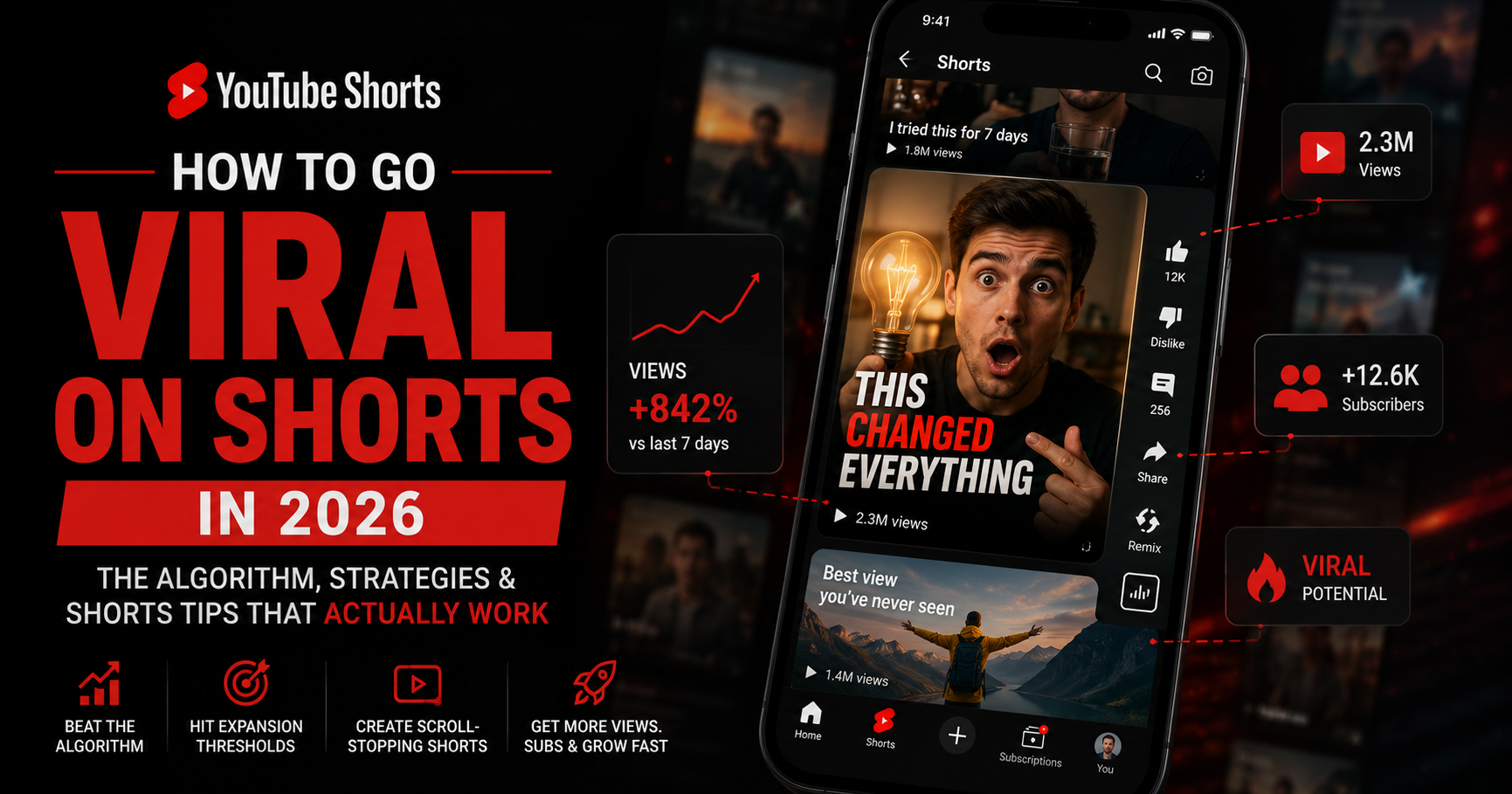
How to Make a YouTube Short Go Viral in 2026 (What the Algorithm Pushes Now)
Every creator wants to know how to make a YouTube Short go viral. The honest answer: no single Short is guaranteed to take off - but you can dramatically improve the odds by understanding what the Shorts algorithm actually pushes in 2026 and engineering each upload around those signals.
Most flatlining Shorts fail the same way every time: weak hooks, missing loops, ignored audio trends, or no consistent posting cadence. Fix those, and you stack the deck on every upload. This guide walks you through exactly what the 2026 Shorts algorithm rewards - and the actionable steps to make your next Short more likely to break out.
Quick Answer
To make a YouTube Short go viral, nail the first 1-2 second hook, design for loops (a strong opening + final frame that connects back), use rising trending audio, post natively without watermarks, and aim for 15-30 second length. The Shorts algorithm tests every Short with a small audience and expands reach based on viewed rate, average percentage viewed, loops, and shares. Improve those signals and you improve viral odds.
Why Do Some YouTube Shorts Go Viral While Others Flatline?
The frustration is real: you post a Short you spent hours on and it stalls at 200 views, while a similar Short from another creator hits 500,000. The difference is rarely luck. The Shorts algorithm tests every upload on a small initial audience pool and decides - based on early engagement - whether to widen distribution. Strong signals trigger expansion; weak signals cap the Short's reach permanently. If your Shorts aren't moving at all, our companion guide on why are my YouTube Shorts not getting views diagnoses the 7 reasons the algorithm skips them entirely. This guide picks up where that one leaves off: what to actively do to give Shorts the best chance to break out.
How Does the YouTube Shorts Algorithm Actually Work in 2026?
The Shorts feed isn't one big serving - it's a series of expansion thresholds. Your Short gets shown to a small initial audience (typically 100-300 viewers). The algorithm measures viewed rate, completion percentage, loops, and shares. If those signals clear the first threshold, your Short expands to a larger audience pool. Clear that threshold and it expands again - and again. "Going viral" is really just clearing several expansion thresholds in sequence.
This means a Short's fate isn't decided once. It's decided dozens of times, at each expansion checkpoint. Every threshold the algorithm tests is another chance for your Short to either keep climbing or get capped. The signals it weighs at each checkpoint are below.
What Signals Determine If a YouTube Short Will Go Viral?
The Shorts algorithm weighs five core signals at every expansion checkpoint. Master them and your Shorts clear more thresholds.
Viewed vs. swiped-away rate
The first signal is whether viewers swipe past or stop to watch. A high swipe-away rate in the first 1-2 seconds tells the algorithm your Short failed to hook. The threshold separating successful Shorts from flatlining ones is harsh - most viral Shorts hold 80%+ of viewers past the first second. If you can't earn that opening attention, no other signal matters.
Average percentage viewed
Once viewers stop, average percentage viewed measures how much of the Short they watch. Shorts averaging 80%+ complete consistently outperform those averaging 50%. Length matters here: shorter Shorts make 80%+ easier to achieve. A 15-second Short at 90% completion crushes a 60-second Short at 40% completion in the algorithm's eyes.
Loops and re-watches
Loops are the secret weapon of viral Shorts. When a viewer watches your Short twice in a row (or three times), the algorithm reads it as massive content satisfaction. Shorts designed to loop - where the final frame visually or thematically connects back to the opening - earn loop signals that compound expansion. Track these inside Channel Analytics.
Shares
A share is the strongest engagement signal a Short can earn - it tells the algorithm a viewer cared enough to send your content to someone outside your audience. Shares trigger faster expansion than any other signal. Shorts that prompt strong emotional reactions (surprise, laughter, anger, awe) earn shares; informational Shorts often don't, even when they're high quality.
Follows earned from a single Short
When a viewer follows your channel directly from a Short, the algorithm reads it as the highest-value outcome possible - your content didn't just satisfy them, it converted them. Shorts that prompt follows earn priority expansion at every subsequent threshold. The fastest way to earn follows is to give viewers a reason to expect more value from your future content.
What Are the Steps to Make a YouTube Short More Likely to Go Viral?
These seven steps engineer your Short to maximize signal strength at every expansion checkpoint:
1. Nail the first 1-2 second hook. Open with the strongest visual or claim. No greetings, no slow setup, no logo. The first frame must demand attention.
2. Design for loops. Engineer the final frame to visually or thematically connect to the opening. Loop-designed Shorts earn re-watches that compound expansion signals.
3. Hit the length sweet spot. Aim for 15-30 seconds. Long enough to deliver value, short enough for high completion. Anything past 45 seconds rarely outperforms unless the content genuinely demands the length.
4. Ride trending audio fast. Browse the Shorts Trending Sounds feed weekly. Use sounds with rising momentum (not yet saturated). The audio-trend window typically lasts 3-7 days before saturation.
5. Go vertical, full-screen, with captions. 9:16 aspect ratio fills the entire screen. Add captions - 80%+ of Shorts are watched without sound. Captions also help algorithmic understanding of the content.
6. Drop other-platform watermarks. TikTok and Instagram watermarks trigger distribution caps. Re-upload the original watermark-free file natively to YouTube Shorts, or crop watermarks cleanly before upload.
7. Post consistently and time it right. The algorithm rewards predictable cadence. Use YouSEO Best Time to Post to publish Shorts during your audience's peak window - early engagement multiplies expansion velocity.
How Should New and Experienced Creators Approach Shorts Differently?
For creators just starting with Shorts
Beginners should focus obsessively on the first 1-2 second hook. Without hook strength, no other signal matters. Don't worry about loops, follows, or audio trends until your hook reliably holds viewers past the swipe-away threshold. Post 10 Shorts focused only on hook quality, then layer in loops, audio, and length optimization. One signal at a time is the fastest path.
For experienced creators turning hits into repeatable reach
If you've had a Short go viral but can't repeat it, open YouSEO Channel Analytics and compare your top 3 Shorts against your bottom 3 across viewed rate, completion, loops, and shares. The pattern that separates them reveals what your audience specifically responds to. Most experienced creators discover that one specific format or hook structure drives 70%+ of their viral hits - find yours and replicate it deliberately.
What Does the Anatomy of a Viral YouTube Short Look Like?
A typical viral Short follows a structure:
- Seconds 0-2: a strong hook - visual surprise, bold claim, or sharp question. Captures attention before swipe instinct fires.
- Seconds 3-12: the core payoff - delivers the promise from the hook, with tight pacing and on-screen captions for sound-off viewers.
- Seconds 13-20: the reveal or twist - the moment that triggers emotional reaction and prompts shares.
- Seconds 21-30: the loop - closing frame that visually or thematically connects back to the opening, triggering re-watches and signaling satisfaction.
No single Short is guaranteed to follow this structure perfectly and still go viral - the algorithm has a luck factor - but Shorts engineered this way consistently outperform those that aren't.
Frequently Asked Questions About YouTube Shorts Going Viral
How long should a YouTube Short be to go viral?
The sweet spot is 15-30 seconds. Shorter Shorts achieve higher completion rates (which the algorithm weights heavily) and earn more loops. Anything past 45 seconds rarely outperforms unless the content genuinely needs the length to deliver the payoff.
Do hashtags actually help YouTube Shorts go viral?
Niche-specific hashtags help marginally. Avoid generic ones like #shorts or #viral - they signal nothing. Use 3 niche-specific hashtags like #BeginnerCooking or #UrbanGardening. These help the algorithm identify your audience profile faster, accelerating early-test distribution.
How many Shorts should I post to go viral?
Most channels need 10-30 Shorts before one breaks out. Consistency beats single-upload optimization. The algorithm uses your historical cadence to calibrate distribution aggressiveness - channels posting daily for 30 days outperform channels posting 10 in one weekend.
Does using trending audio guarantee my Short will go viral?
No, but it significantly improves your odds. Trending audio earns a temporary distribution boost from the algorithm during the trend's rising 72-hour window. Riding a trend late or using saturated audio offers no benefit - only fresh trending sounds move the needle.
Can a small channel make a YouTube Short go viral?
Yes - channel size doesn't gate Shorts virality. The algorithm tests every Short on a small audience pool regardless of subscriber count. A 50-subscriber channel and a 50,000-subscriber channel face the same expansion thresholds. The signals on the upload matter far more than the channel size posting it.
How Do You Apply This to Your Next YouTube Short?
Virality is a probability game. Each step above moves your odds higher; no step guarantees a hit. Apply all seven on your next three Shorts, then study what worked and what didn't. Patterns emerge within 10-15 uploads - once you find your channel's specific viral formula, you can replicate it deliberately.
See which Shorts take off and why - viewed rate, average view percentage, and shares - with Channel Analytics. And post each Short when your audience is most active to give it early momentum with Best Time to Post. Try YouSEO free today.