
What Should I Make a YouTube Video About? How to Never Run Out of Ideas
If you've ever frozen at the question "what should I make a YouTube video about?" - you're not alone. The blank-screen feeling is the single most common reason creators slow down or quit. The good news: how to come up with YouTube video ideas isn't really a creativity problem. It's a systems problem.
Creators who never run out of ideas don't have more inspiration than you. They have repeatable sources they mine every week - audience questions, search data, competitor moves, their own expertise. This guide gives you that toolkit, so you'll never stare at an empty content calendar again.
Quick Answer
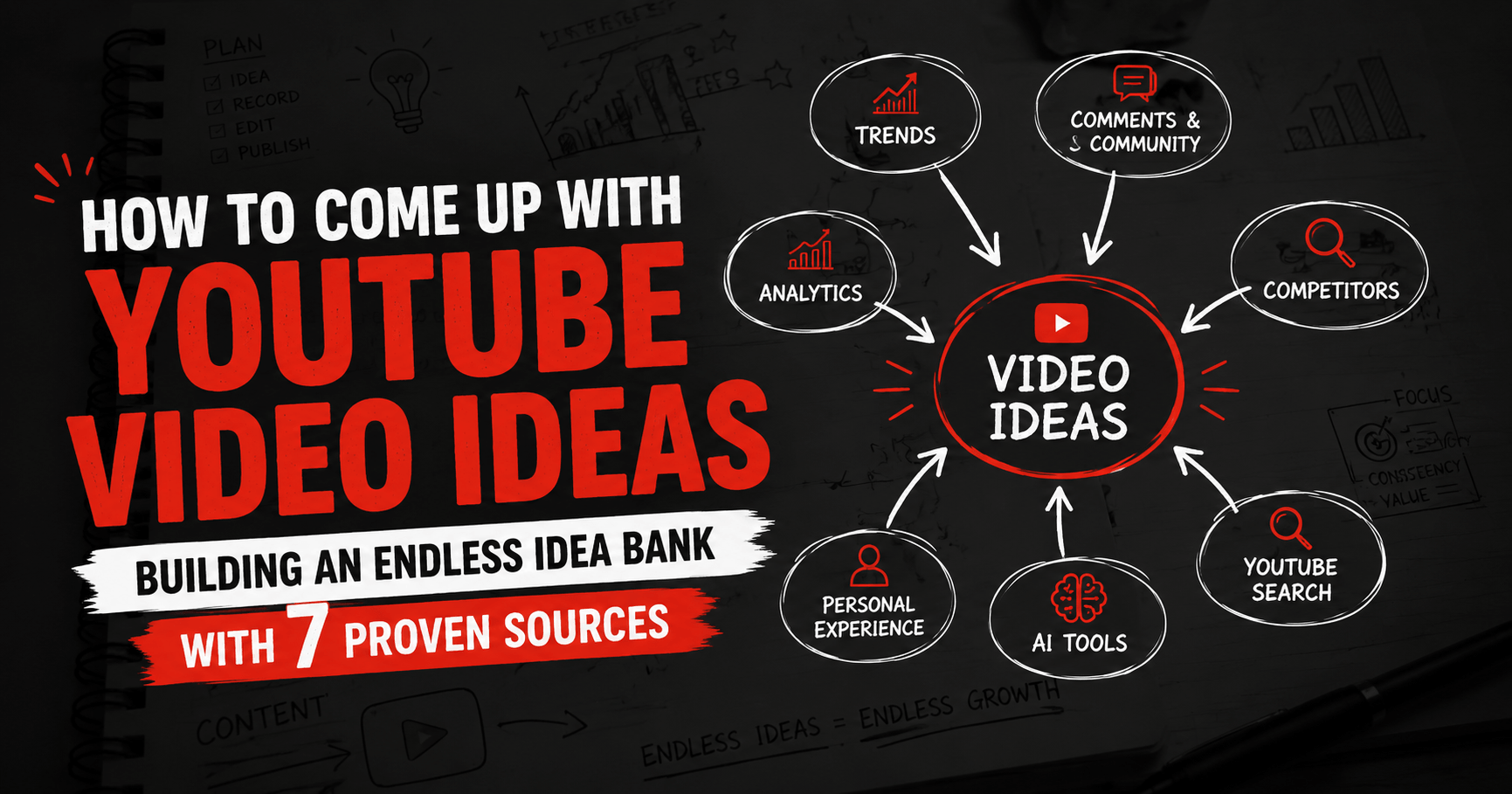
To come up with YouTube video ideas reliably, mine seven sources: viewer comments and questions, keyword research, competitor and adjacent channels, trending topics, your own past content repurposed into new angles, your content pillars, and your personal expertise and experiences. Capture ideas continuously into one bank, then validate each idea against search demand before filming.
Why Do Creators Run Out of YouTube Video Ideas?
Most creators rely on flashes of inspiration - they wait for the next good idea to hit while they're brushing their teeth or scrolling YouTube. Inspiration is unreliable. Worse, it's biased - your brain returns to similar ideas because that's how memory works. Creators who publish consistently for years don't have a better imagination. They have repeatable systems that surface ideas on demand. Once you replace "wait for inspiration" with "mine my sources," the bottleneck shifts from idea generation to execution - which is exactly where you want it.
What Are the Best Methods to Come Up With YouTube Video Ideas?
1. Mine audience questions from comments and the community tab
Your existing viewers tell you what to make next - for free, every day. Open your YouTube comments and the Community tab posts you've published. Look for repeated questions, confusion, or requests. Each one is a video idea pre-validated by the people most likely to watch it. Pin a comment asking "what should I cover next?" - the responses become a backlog of ready-made topics.
2. Use keyword research and search demand
Search data shows you what people are actively typing into YouTube right now. Every search query is a potential video topic with proven demand attached. Use a keyword research tool to surface 50+ related queries in your niche, filter for rising-velocity terms with reachable competition, and you'll have weeks of ideas already validated. We cover the full workflow in our companion guide on how to find the right keywords for your YouTube videos.
3. Study competitor and adjacent channels
Open channels in your niche and adjacent niches and sort their videos by view count. The top performers reveal which topics audiences in your space want more of. Don't copy - adapt. Pick a topic that worked on a similar channel and bring your own angle, expertise, or contrarian take. Adjacent niches especially are gold: their winning topics often fit your audience but haven't been done in your niche yet.
4. Ride trends carefully
Trending topics offer short-term reach, but only if you publish while the trend is rising - not after it peaks. Browse Google Trends and YouTube's Trending tab weekly. Identify trends related to your niche, not random viral moments. The sweet spot: a trend with 3-7 days of rising momentum that your audience would care about regardless. Avoid chasing trends outside your niche - algorithmic punishment is harsh.
5. Repurpose one topic into many angles and formats
Every topic supports five videos, not one. Take "how to start a podcast." That single topic becomes: how to start (overview), 5 mistakes to avoid, equipment guide, content planning template, and monetization options. Same research, five separate uploads. The repurposing question: "What sub-question would someone still have after watching this?" Each sub-question is the next video.
6. Build content pillars
Content pillars are 3-5 recurring topics your channel covers regularly. They give viewers consistency and give you predictable idea sources. If your pillars are budget travel, photography, and remote work, every week you generate one idea per pillar - three videos a month minimum, before any trending or audience-question topics layer in. Pillars also help the algorithm understand your channel's themes.
7. Mine your own expertise and experiences
Your background is a content source most creators ignore. Past jobs, struggles, surprising lessons, failed experiments, things you wish you'd known - each becomes a video. The audience doesn't want a guru; they want a real human sharing real experience. Make a one-page list of every meaningful skill, job, mistake, and turning point in your life. That list is six months of content.
How Do You Build an Endless YouTube Idea Bank?
Use this workflow to convert the seven methods above into a steady idea pipeline:
1. Set up your sources. Make a one-page document listing all seven methods as headers. Each becomes a section in your idea bank.
2. Capture continuously. Add ideas as they hit, from any source. One sentence per idea is enough. Aim for 5+ new ideas captured per week.
3. Tag each idea. Note which method generated it and which content pillar it fits. Tagging surfaces patterns later - you'll see which sources produce your best ideas.
4. Reframe one topic into multiple videos. Each captured idea should be expanded into 3-5 angles before filming. Ask: what would someone still want to know after this?
5. Validate before filming. No idea makes it to the camera until it passes a quick search demand check (next section). Time spent validating beats time wasted filming the wrong topic.
How Do You Validate a YouTube Video Idea Before You Film?
Validation takes five minutes. Open the YouSEO Keyword Research tool and search your candidate topic. Check three things: monthly search volume (aim for at least 500), competition score (reachable for your channel size), and whether top-ranking results match your intended format. If volume is healthy, competition is reachable, and the format fits, film it. If any of the three fails, either reshape the idea (different angle, different format) or move to the next candidate. Validation prevents the most expensive mistake on YouTube: filming the wrong topic.
How Should New and Established Creators Find Ideas Differently?
For brand-new creators with no audience data yet
If you have no audience yet, you can't mine comments or analytics - so lean heavily on keyword research, competitor channels, and your own expertise. Your goal in the first 20 uploads is to discover what your audience actually responds to. Cast a wider net than you would later: experiment with three different sub-niches under your umbrella, then double down on whichever generates the strongest retention and CTR.
For established creators with audience and analytics
Channels with audience data should weight comment-mining and analytics heavily. Open YouSEO Channel Analytics to see which past videos earned the highest watch time - those topic patterns reveal what your specific audience wants more of. The biggest opportunity for established creators isn't new ideas; it's doubling down on what already works. One topic that earned 200K views deserves five spinoff angles, not one.
Frequently Asked Questions About YouTube Video Ideas
How many video ideas should I have in my bank at any time?
Aim for at least 30 captured ideas at all times. That gives you enough variety to pick the best fit for your weekly upload and enough buffer to survive a low-inspiration week. Most experienced creators carry 100+ ideas in their banks.
How do I know if my YouTube video idea is good?
A good idea passes three tests: it has measurable search demand, the competition is reachable for your channel size, and you have a genuine angle that's not already saturated. Run every candidate through these three filters before filming.
Should I copy successful videos from other channels?
Copy the topic, not the execution. Adapt successful topics from competitor and adjacent channels with your own angle, expertise, or contrarian take. The algorithm doesn't reward replicas - it rewards original treatments of topics with proven audience demand.
How long should an idea sit in my bank before filming?
Most ideas should be filmed within 4-6 weeks of capture, while the source signal (trend, comment, search trend) is still relevant. Evergreen ideas can sit longer. Trend-tied ideas need to be filmed within days of capture before the window closes.
Can I make YouTube videos about my personal experiences?
Yes - personal experience is one of the highest-trust content sources on YouTube. Specific personal stories, failures, and lessons consistently outperform generic advice videos. Authenticity from genuine experience reads as expertise to both viewers and the algorithm.
How Do You Turn Idea Generation Into a Weekly System?
Idea generation stops feeling like writer's block the moment it becomes a system. Pick the three methods that fit your time and skills best, set aside 30 minutes a week to mine each one, and your bank refills faster than you can publish.
Turn search demand into a steady stream of validated ideas with the YouSEO Keyword Research tool. Then double down on what's already working by checking which past topics performed best in Channel Analytics. The combination - search-validated new ideas plus data-proven existing wins - is the closest thing to an endless content engine. Try YouSEO free today.