
YouTube View Count Change 2026: Why Your Views Are About to Jump — and What It Actually Means
Published August 18, 2026 · Updated August 18, 2026 · Based on YouTube's official announcement of August 17, 2026
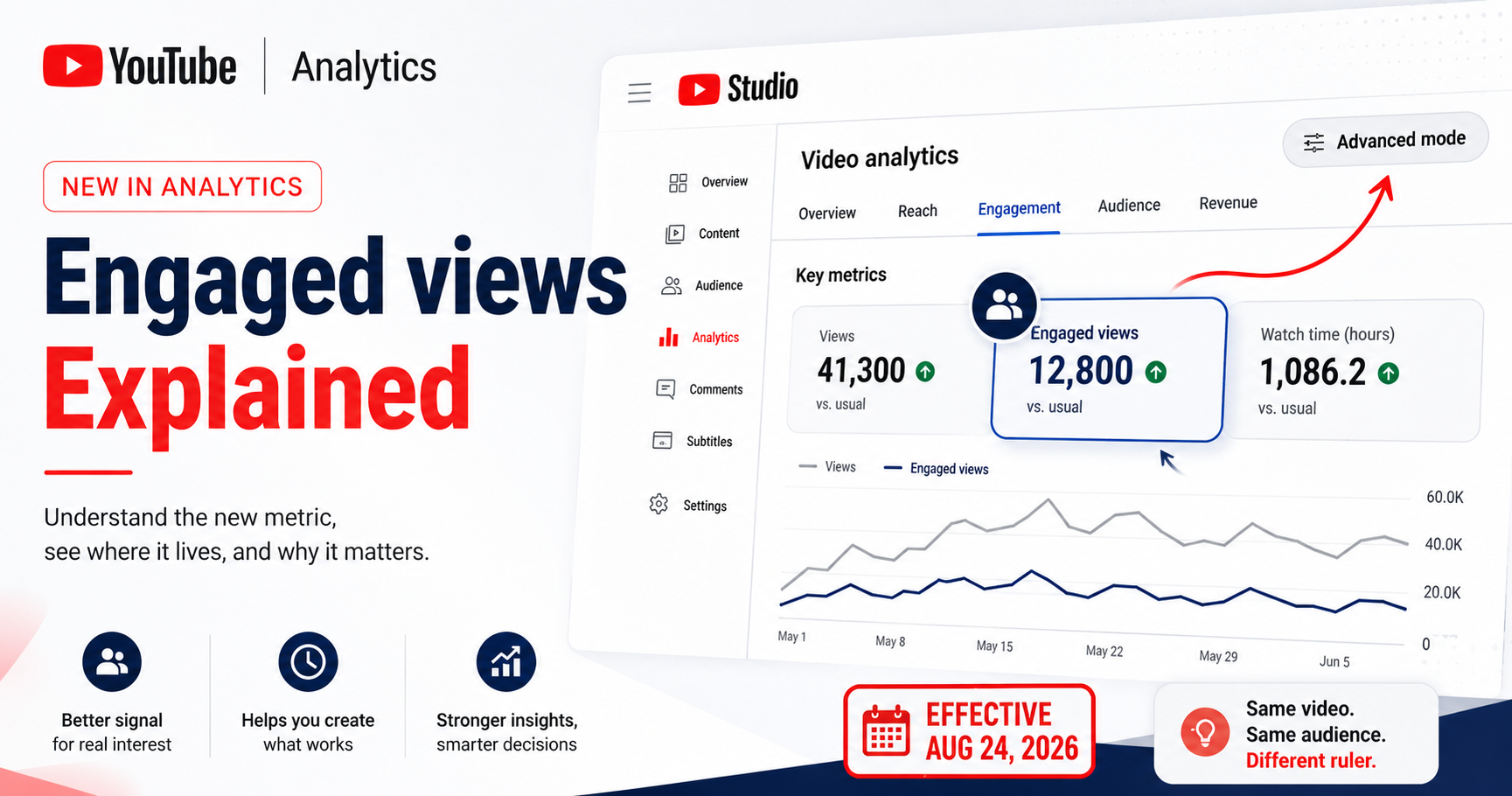
Starting August 24, 2026, YouTube counts a view the moment a video begins to play — from the very first frame — across all formats, globally. Your view counts will start climbing faster, but nothing about your content or your audience has changed: the ruler changed, not the room. Here's exactly what's different, what isn't, and how to read your numbers so you don't fool yourself — or get fooled.
The short version: From August 24, 2026, a YouTube view is counted from the first frame of playback, on all video formats worldwide. The original metric survives as "Engaged views" in YouTube Analytics → Advanced Mode. Earnings and YouTube Partner Program eligibility are not affected — those still run on Engaged Shorts views and Engaged Watch Hours.
What Exactly Is Changing on August 24, 2026?
One thing: when a view gets counted. Per YouTube's official announcement on August 17, a view is counted the moment a video begins to play — from the very first frame — and that standard now applies globally, across all formats. the same applies when someone enters a live broadcast.
What was it before? Honestly, nobody outside YouTube knows precisely — and that's the point of the change. YouTube never officially disclosed its long-form threshold; TechCrunch notes it was generally understood to be around 30 seconds of watch time. Treat that as the widely-held convention, not a published rule. Shorts already worked the new way: YouTube applied first-frame counting to Shorts back in March 2025, and this update brings every other format in line with that standard.
The one-line version worth remembering: before August 24, a view meant "someone watched a meaningful chunk." After August 24, a view means "the video started playing." Same videos, same viewers, different definition.
Why Is YouTube Making This Change?
In YouTube's words: consistency. The announcement says that historically, YouTube used multiple view counting systems across different formats, and that creators wanted to "eliminate this metric confusion and accurately understand their true exposure." If you post both long-form videos and Shorts, you've been reading two different metrics with the same name on the same dashboard — that ends on August 24.
There's also an industry context worth naming: TechCrunch points out that TikTok and Instagram already count views as soon as a video starts playing. So this move brings YouTube's public view number onto the same basis as the platforms creators are usually compared against. YouTube frames the benefit in exactly those terms — metric parity across formats gives creators a clearer picture of overall exposure and makes it easier to confidently express their true scale and value to brand partners and sponsors.
How Much Will Your View Counts Actually Jump?
Nobody can tell you a number, and anyone quoting a specific percentage is guessing — YouTube hasn't published one, and the honest answer is that it depends entirely on your content. This part is our analysis: the size of your jump is a function of how many people currently start your videos and leave before the old threshold. A channel whose viewers reliably settle in for several minutes will barely notice the change, because most of those plays were already being counted. A channel that gets a lot of curious clicks that bounce in the first few seconds will see a much larger gap open up between Views and Engaged views.
That gap is itself the most interesting number you'll get out of this. Once both metrics are running side by side, Views minus Engaged views is a rough measure of how many people arrive and immediately leave — which is a packaging-and-promise signal worth watching. TechCrunch's broader point is worth keeping in view too: if counts rise significantly, especially for videos that only briefly capture attention, then public view counts become weaker evidence of how popular something actually is. That's true for your own videos, and it's equally true for every channel you benchmark yourself against.
Views vs. Engaged Views: What's the Difference Now?
"Views" is now a reach metric — how many times your video started playing. "Engaged views" is the original metric, kept in YouTube Analytics → Advanced Mode, showing how many viewers chose to continue watching. From August 24, you effectively have two numbers where you used to have one, and they answer different questions:
| Views (from Aug 24, 2026) | Engaged views | |
|---|---|---|
| What it counts | A view the moment a video begins to play — from the very first frame; also when someone enters a live broadcast | The original view metric: how many viewers chose to continue watching |
| Where it appears | Everywhere views are shown on YouTube — the public view count under your video | YouTube Analytics → Advanced Mode |
| Best used for | Reach and exposure — how many times your video started playing | Real audience health — how many people actually stayed |
| Used for earnings? | No | Yes — earnings continue to be based on Engaged Shorts views and Engaged Watch Hours |
| Applies to | All formats, globally (Shorts already worked this way) | Available to creators in Analytics |
Source: YouTube's announcement, August 17, 2026, and YouTube's Help Center article on the new views metric.
The practical habit to build now: treat Views as your reach number and Engaged views as your health number. Reach tells you how far the packaging traveled; Engaged views tells you whether the content held. Both matter, and confusing them is how creators end up celebrating a number that didn't change anything. YouTube's Help Center article on the new views metric has the official definitions if you want them side by side.
Will This Affect Your YouTube Earnings or Monetization?
No. YouTube states directly that this change will not impact creators' earnings or how they become eligible for the YouTube Partner Program. Earnings continue to be based on Engaged Shorts views and Engaged Watch Hours — both of which you'll find in YouTube Analytics → Advanced Mode. The inflated public view number is not a payable metric, and it never becomes one under this update.
One naming change does come with it. YPP entry requirements are being renamed: "valid public Shorts views" becomes "qualified Shorts views," and "valid public watch hours" becomes "qualified watch hours." The requirements themselves aren't changing in this announcement — only the labels. You can check the current criteria on YouTube's YPP eligibility page. If that word "qualified" looks familiar, it's because it also appears in YouTube's separate August 10 announcement about 2027 threshold changes — more on how those two connect below.
What This Means for Sponsorships and Brand Deals
This section is our analysis, not YouTube's statement — treat it as informed opinion. YouTube's own framing is that metric parity makes it easier for creators to express their scale to brand partners. That's genuinely true in one direction: if you also post on other platforms, your YouTube numbers are now counted on a comparable basis, which makes cross-platform media kits less of an apples-to-oranges exercise.
The other direction deserves equal honesty. TechCrunch's analysis is that view counts could rise significantly — especially for videos that only briefly capture attention — and that public view counts may no longer be a useful tool for judging how popular a video really is. If that holds, experienced sponsors will adapt, and the ones who know the platform will start asking for the engaged number. That's not a threat to creators; it's an advantage for the ones who are ready. Knowing your Engaged views, your average view duration, and your click-through rate — and being able to explain them in a pitch — is a stronger negotiating position than a bigger headline number that every competing creator also just received.
What Creators Should Do Before and After August 24
Six concrete steps, most of them taking minutes:
1. Screenshot your baseline this week. Before August 24, capture your channel's current 28-day views, plus the view counts on your recent uploads. Once the counting method changes, you can't recover a clean "before" picture.
2. Find Engaged views now, not later. Open YouTube Analytics → Advanced Mode and locate the metric before you need it. Knowing where it lives turns a confusing week into a boring one.
3. Stop comparing across the line. A video published August 30 and a video published August 10 are measured differently. Any comparison that straddles August 24 is measuring the ruler, not the content.
4. Annotate your reporting. If you keep a spreadsheet, a media kit, or client reports, add a note: "YouTube view counting methodology changed 8/24/2026." Anyone reading your numbers later — including future you — needs that footnote.
5. Re-anchor on the signals that didn't change. Engaged views, average view duration, and click-through rate still mean what they meant last month. If you're unsure how to read CTR properly, our guide to what a good CTR actually is covers the benchmarks and the context rule most creators miss.
6. Update your sponsor materials deliberately. Lead with reach if it helps, but have the engaged number ready. Volunteering it before you're asked reads as confidence, not weakness.
If you report numbers to anyone else — a client, an agency, a brand, a team lead — add one more step: tell them before August 24, not after. A short note explaining that YouTube is changing its counting method on that date, and that view figures before and after aren't directly comparable, takes two minutes to send and prevents the awkward conversation where a jump looks like something you did, or a later correction looks like something you hid. The same applies in reverse when you receive numbers: a creator's August-to-September growth chart needs that footnote before you read anything into it.
On tooling, one disclosure and one suggestion: YouSEO publishes this blog. If you want the audit side of that checklist handled in one place, our video and channel audit tools score your uploads and list specific fixes, and the analytics tools track the metrics that still mean what they meant — free to start, on Android, iOS, and the web. YouSEO can never change, edit, delete, or upload anything on your channel; your channel remains fully in your control.
How This Connects to YouTube's 2026 Monetization Changes
This is the second major creator-metrics announcement in eight days, and the two are related by vocabulary. On August 10, YouTube announced that from February 1, 2027, new YPP applicants will need 8,000 qualified watch hours over the past year or 20 million qualified Shorts views over 90 days — up from 1,000 subscribers plus 4,000 watch hours, or 1,000 subscribers plus 10 million Shorts views — while existing partners will need 10 million Shorts views over 90 days to keep earning from Shorts. TechCrunch reports that announcement drew backlash from creators. We covered it in full in our breakdown of YouTube's 2027 Partner Program changes.
Read together, the pattern is a vocabulary shift. "Views" now means exposure. "Engaged" means the watching that pays. "Qualified" means the counting that unlocks monetization. Three words, three different jobs — and the creators who keep them straight will read their own dashboards correctly while everyone else argues about a number that got easier to earn.
Frequently Asked Questions
Why did my views suddenly increase?
If it happened on or after August 24, 2026, it's almost certainly the counting change: YouTube now counts a view from the very first frame of playback instead of after sustained watching. YouTube itself said creators will likely see total view counts increase faster from that date. Your content and audience didn't change — the definition did.
Will my old videos' view counts change retroactively?
YouTube hasn't said that past views will be recalculated. The announcement says the new metric applies from August 24, 2026 onwards, wherever views are shown — it doesn't address retroactive restatement either way. Until YouTube clarifies, treat pre-August-24 numbers as measured under the old method and don't assume a backfill.
Where do I find Engaged views?
YouTube Analytics → Advanced Mode. Engaged views is the original view metric, kept there so creators can see how many viewers chose to continue watching. It's also the family of metrics your earnings run on, alongside Engaged Watch Hours.
Do live streams count under the new rule?
Per TechCrunch's reporting, a view is counted as soon as someone enters a live broadcast — the same first-moment logic applied to on-demand videos. Expect live view counts to behave like every other format from August 24 onward.
Does this change YPP requirements?
No. YouTube states there is no change to YPP eligibility from this update, and earnings continue to be based on Engaged Shorts views and Engaged Watch Hours. The entry requirements are simply being renamed — "qualified Shorts views" and "qualified watch hours" replace "valid public Shorts views" and “valid public watch hours.”
Should I still care about my public view count?
Yes, as a reach signal — it tells you how many times your video started playing, which is real information about distribution. Just don't read it as a popularity or quality score anymore. For that, use Engaged views and average view duration, which measure whether people stayed.
The Bottom Line
On August 24, 2026, YouTube starts counting a view from the first frame, across every format, worldwide. Your public numbers will look bigger; your earnings, your YPP eligibility, and your actual audience will be exactly what they were on August 23. The creators who come out ahead won't be the ones celebrating the new number — they'll be the ones who screenshot their baseline, learn where Engaged views lives, and can explain both numbers to a sponsor without flinching.
Bigger numbers, same reality. Know which one you're looking at, and you'll read your channel more clearly than most people will for the next few months. If you want help auditing what your uploads are actually doing, YouSEO is free to start on Android, iOS, and the Web App.