
YouTube Partner Program Changes 2027: New Requirements, Deadlines, and What Creators Should Do Now
Published August 10, 2026 · Last updated August 15, 2026 · Based on YouTube's official announcement of August 10, 2026
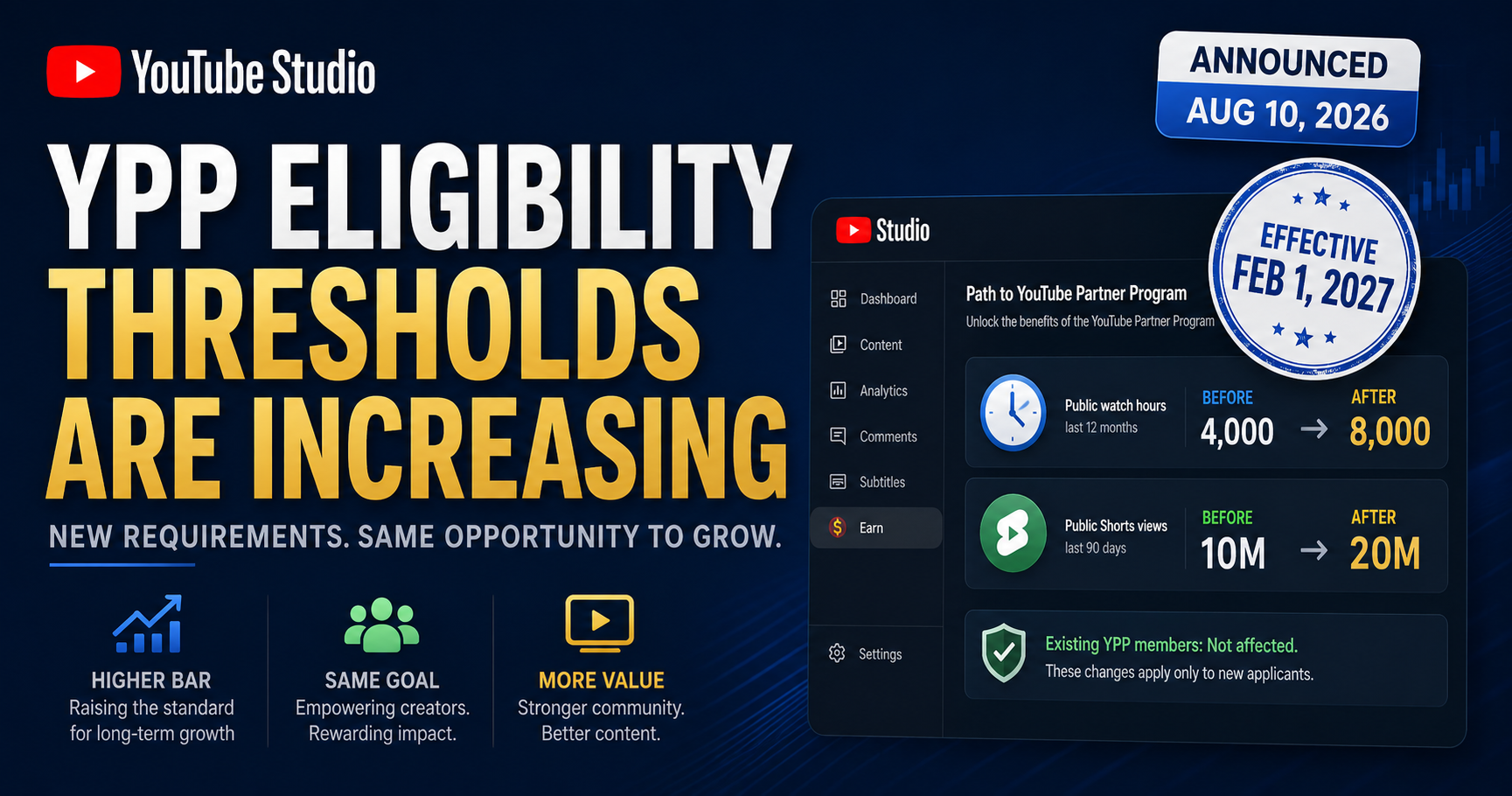
On August 10, 2026, YouTube announced the biggest YouTube Partner Program changes since 2018 — effective February 1, 2027. Three things are changing, per YouTube's official announcement: Premium Lite is expanding worldwide, Shorts revenue sharing is getting a 10-million-view threshold, and the entry requirements for new creators joining ads revenue sharing are doubling — to 8,000 qualified watch hours or 20 million qualified Shorts views.
Here's the sentence that matters most, straight from YouTube: the new entry requirements won't impact creators already in YPP. That means the next few months matter enormously for anyone close to today's thresholds — qualify before February 1, 2027, and you enter under the current, meaningfully lower bar. This guide covers everything in the announcement, exactly as YouTube stated it, and what to do with the time between now and the deadline.
What Is the YouTube Partner Program?
The YouTube Partner Program (YPP) is how creators earn directly from YouTube: revenue sharing on ads and Premium subscriptions, Shorts revenue sharing, plus Fan Funding (memberships, Super Thanks, Super Chat) and YouTube Shopping. It launched almost twenty years ago and now includes more than 3 million creators. Entry works in tiers — a lower bar unlocks fan funding and Shopping, a higher bar unlocks ad revenue sharing. Our full guide to how to earn money from YouTube walks the whole ladder; here we cover what's changing.
What's Changing in the YouTube Partner Program in 2027?
From February 1, 2027, YouTube is making three changes: expanding Premium Lite worldwide, adding a 10-million-view threshold for Shorts revenue sharing, and doubling the entry requirements for new creators joining ads revenue sharing. Here's the full picture, today versus February 1:
| Today (until Jan 31, 2027) | From Feb 1, 2027 | |
|---|---|---|
| YPP ads entry — long-form (new applicants) | 1,000 subs + 4,000 public watch hours (12 months) | 8,000 qualified watch hours (last 365 days) |
| YPP ads entry — Shorts (new applicants) | 1,000 subs + 10M Shorts views (90 days) | 20M qualified Shorts views (last 90 days) |
| Shorts revenue sharing (existing members) | Available in YPP | Requires 10M qualified Shorts views / 90 days (auto-resumes when re-crossed) |
| Fan Funding & Shopping thresholds | Current tiers | Unchanged |
| Creators already in YPP | Monetized | Not affected by the new entry thresholds (per YouTube) |
Source: YouTube's official announcement, August 10, 2026. "Qualified" watch hours and Shorts views are YouTube's terms — explained below.
Change 1 — Premium Lite Expands Worldwide
Premium Lite is YouTube's lower-priced subscription — uninterrupted viewing of most content without the full Premium bundle — and it's expanding to every country where YouTube Premium is offered. The creator-side mechanics, per the announcement: 30% of net Premium subscription revenue and 60% of net Premium Lite revenue go into creator pools, distributed by member watch time and views; from those pools, creators receive 55% of allocated revenue for long-form and 45% for Shorts. YouTube says that, on average, a Premium subscriber earns a partner more than the same user watching ads — that's YouTube's own claim, based on its 2026 performance data. For most creators this is the quiet good news of the announcement: a second, growing revenue stream that requires nothing new from you. (For context on what ad views pay today, see how much YouTube pays per 1,000 views.)
Change 2 — Shorts Revenue Sharing Gets a Threshold
From February 1, 2027, ads and subscription revenue sharing on Shorts requires 10 million qualified Shorts views over the last 90 days. Two reassurances, both directly from YouTube: channels below that line stay in YPP and keep earning on long-form content — falling short doesn't remove you from the program — and Shorts revenue sharing resumes automatically once a channel crosses 10 million again. YouTube's framing: creators already earning significant Shorts revenue are unlikely to be impacted.
For channels below the threshold, YouTube announced new incentive programs — bonuses for YouTube Shopping, incentives for brand deals, and earnings boosts for starting and growing trends. Important honesty note: these are announced but unspecified. YouTube says details are coming; nobody outside YouTube knows the amounts or mechanics yet, and anyone claiming to is guessing. We'll update this post when YouTube publishes them. If your Shorts are far from these numbers today, the fundamentals still come first — see why your Shorts get no views.
Change 3 — Entry Requirements Double for New Creators
The headline change. New creators applying for YPP ads and Premium revenue sharing from February 1, 2027 will need 8,000 qualified watch hours in the last 365 days, or 20 million qualified Shorts views in the last 90 days — double today's 4,000 hours and 10 million views. YouTube's announcement specifies the new watch-hour and Shorts-view thresholds; the subscriber requirement was not changed in the announcement. "Qualified" is YouTube's specific term for its updated counting method for watch hours and Shorts views — see YouTube's official definition for exactly what counts.
Two things did not change, and they matter most for small creators. First, YouTube states plainly: this update won't impact creators already in YPP. Second, the entry thresholds for Fan Funding and Shopping remain unchanged — the first-earnings ladder (memberships, Super Thanks, Super Chat, Shopping) stays reachable at today's lower bar even after February 1. New terms can be reviewed and signed in YouTube Studio and take effect February 1, 2027. YouTube's context for the change: more than 200 billion daily Shorts views, over a billion hours of daily watch time on TV screens, 3 million+ creators in the program — and, in YouTube's words, it expects to pay creators more in 2027 than in 2026.
Why Is YouTube Making These Changes?
YouTube's own framing, worth reading on its terms: the platform's scale has transformed since the thresholds were last set — the announcement cites more than 200 billion daily Shorts views and over a billion hours of daily watch time on TV screens — and with 3 million+ creators already in the program, YouTube says it's making the first significant changes since 2018 "to ensure that YPP continues to be the leader in the creator economy by meaningfully rewarding active creators." The company pairs the higher bar with a spending claim: it expects to pay creators more in 2027 than it did in 2026, shifting some rewards from pure ad revenue toward the new milestone incentives and the expanded Premium pools. Whether that trade works out per creator will only be visible once the incentive details exist — but the direction is explicit: fewer, more active channels sharing larger pools.
Who Is Affected — and Who Isn't?
The short version, per YouTube's announcement:
- Already monetized before February 1, 2027: not affected by the new entry thresholds, per YouTube. Standard program policies still apply, as always.
- Applying after February 1, 2027: the new thresholds apply — 8,000 qualified watch hours or 20 million qualified Shorts views.
- Monetized Shorts-focused channels: Shorts revenue sharing now depends on maintaining 10 million qualified views per 90 days; long-form earnings continue regardless, and Shorts sharing auto-resumes on re-crossing.
- Small creators pursuing Fan Funding and Shopping: unchanged — those entry tiers stay where they are today.
The Window Before February 1, 2027 — What It Means
Here's the practical heart of the announcement. Because the new thresholds apply only to new applicants, there's a roughly five-and-a-half-month window — now through January 31, 2027 — in which qualifying under today's requirements means entering under today's requirements. For a creator sitting at 2,500 watch hours or a few million Shorts views, that's a very different project than starting over against a doubled bar: reaching 4,000 watch hours is meaningfully more achievable than reaching 8,000.
And the honest limits, stated plainly because they're true: nobody can guarantee monetization — not us, not anyone. Approval requires meeting the thresholds and passing YouTube's review, including its monetization policies, and YouTube alone decides acceptance. What the window changes is the size of the hill, not the existence of the review. If you're within reach of today's numbers, the next five months are the time to work systematically — our guide to reaching 4,000 watch hours [4,000-WATCH-HOURS POST — wire our existing guide's slug] covers the long-form path in depth.
What working the window looks like in practice, starting this week: know your exact numbers (YouTube Studio → Analytics shows your current 365-day watch hours and 90-day Shorts views — write them down and date them); do the arithmetic (the gap to 4,000 hours, divided by the weeks remaining, is your weekly target — a channel at 2,500 hours needs roughly 60-70 hours a week through January, which is a real but plannable number); then weight your effort toward what compounds — longer-retaining videos on topics with proven demand add watch hours faster than more uploads of the same length, and your existing catalog often hides the fastest wins: an old video with strong retention but weak packaging is a watch-hours asset waiting for a better title and thumbnail.
How to Make the Most of the Next Few Months
A monetization push is really four kinds of work, repeated weekly: diagnosing what's holding your channel back, packaging each upload to earn its impressions, choosing topics people actually watch, and tracking progress against the threshold. That's the work YouSEO — the toolkit that publishes this blog (here's what YouSEO is in full) — is built for, with 33 tools across Video (15), Shorts (8), Audit (6), and Analytics (4):
- Audit tools grade your existing videos and list specific fixes — the fastest way to find what's suppressing watch time in content you've already made.
- Video tools help each new upload earn more: title options, descriptions, tags, and a Thumbnail Click Score that predicts a thumbnail's click appeal before you publish.
- Shorts tools cover the Shorts-views path with Shorts-specific SEO analysis, titles, hashtags, and trending topics.
- Analytics tools track your watch-hour progress toward the threshold so the push stays measurable, week by week.
To be precise about what a tool can and can't do: YouSEO helps you plan, create, optimize, and analyze — it does not produce watch hours, and no tool can promise monetization. It's free to start, on Android, iOS, and the web, used by creators all around the world at every stage of the ladder — first channel, monetization push, and beyond — and rated 4.7★ on Google Play (45.4K reviews, 1M+ downloads) and 4.8★ on the App Store as of August 2026. One more thing worth saying plainly, since a monetization push involves your channel data: YouSEO can never change, edit, delete, or upload anything on your channel.
Frequently Asked Questions
When do the new YouTube Partner Program requirements take effect?
February 1, 2027. YouTube announced the changes on August 10, 2026, and creators can review and sign the new terms in YouTube Studio before they take effect. Applications approved under today's thresholds before that date fall under the current requirements.
Will already-monetized channels lose monetization?
No — YouTube states directly that the update won't impact creators already in YPP. The new entry thresholds apply to new applicants. Existing members remain subject to YouTube's standard program policies, as they are today, and monetized Shorts channels have the new 10-million-view condition for Shorts revenue sharing specifically.
What are the new requirements to monetize on YouTube?
From February 1, 2027, new applicants for ads and Premium revenue sharing need 8,000 qualified watch hours in the last 365 days or 20 million qualified Shorts views in the last 90 days — double today's 4,000 hours or 10 million views. The announcement didn't change the subscriber requirement, and Fan Funding and Shopping entry tiers are unchanged.
What are "qualified" watch hours and Shorts views?
"Qualified" is YouTube's term for its updated method of counting watch hours and Shorts views toward these thresholds. YouTube links its own definition from the announcement — check the official explainer for exactly what counts before planning against the numbers.
Can small channels still earn before reaching the ads threshold?
Yes. The entry thresholds for Fan Funding (memberships, Super Thanks, Super Chat) and YouTube Shopping remain unchanged by this announcement — the first-earnings ladder stays reachable at today's lower bar, before and after February 1, 2027.
What happens if a monetized channel drops below 10 million Shorts views?
It stays in YPP and keeps earning on long-form content — falling below the line pauses Shorts revenue sharing only. Per YouTube, Shorts revenue sharing resumes automatically once the channel crosses 10 million qualified views in 90 days again. YouTube has also announced incentive programs for channels below the threshold, with details still to come.
Is there still time to get monetized under the current rules?
Yes — the current thresholds (1,000 subscribers plus 4,000 watch hours or 10 million Shorts views) apply until February 1, 2027, and YouTube says existing YPP members aren't affected by the new entry bar. Qualification still requires passing YouTube's standard review, and no one can guarantee approval — but the window to qualify under today's requirements is real, and it's about five months.
The Bottom Line
Three changes, effective February 1, 2027: Premium Lite goes worldwide with defined creator revenue pools; Shorts revenue sharing gets a 10-million-view threshold with a stay-in-program safety net; and entry requirements double for new creators — while existing YPP members, in YouTube's own words, aren't impacted. The date to circle is February 1, 2027, and for creators near today's thresholds, the months before it are the most valuable stretch of the year.
If you're making the push, work it systematically: audit what you have, package every upload properly, and track the hours weekly. YouSEO is free to start on Android, iOS, and the Web App — no promises about the outcome, just the toolkit for the work. We'll update this post as YouTube releases the incentive-program details.