
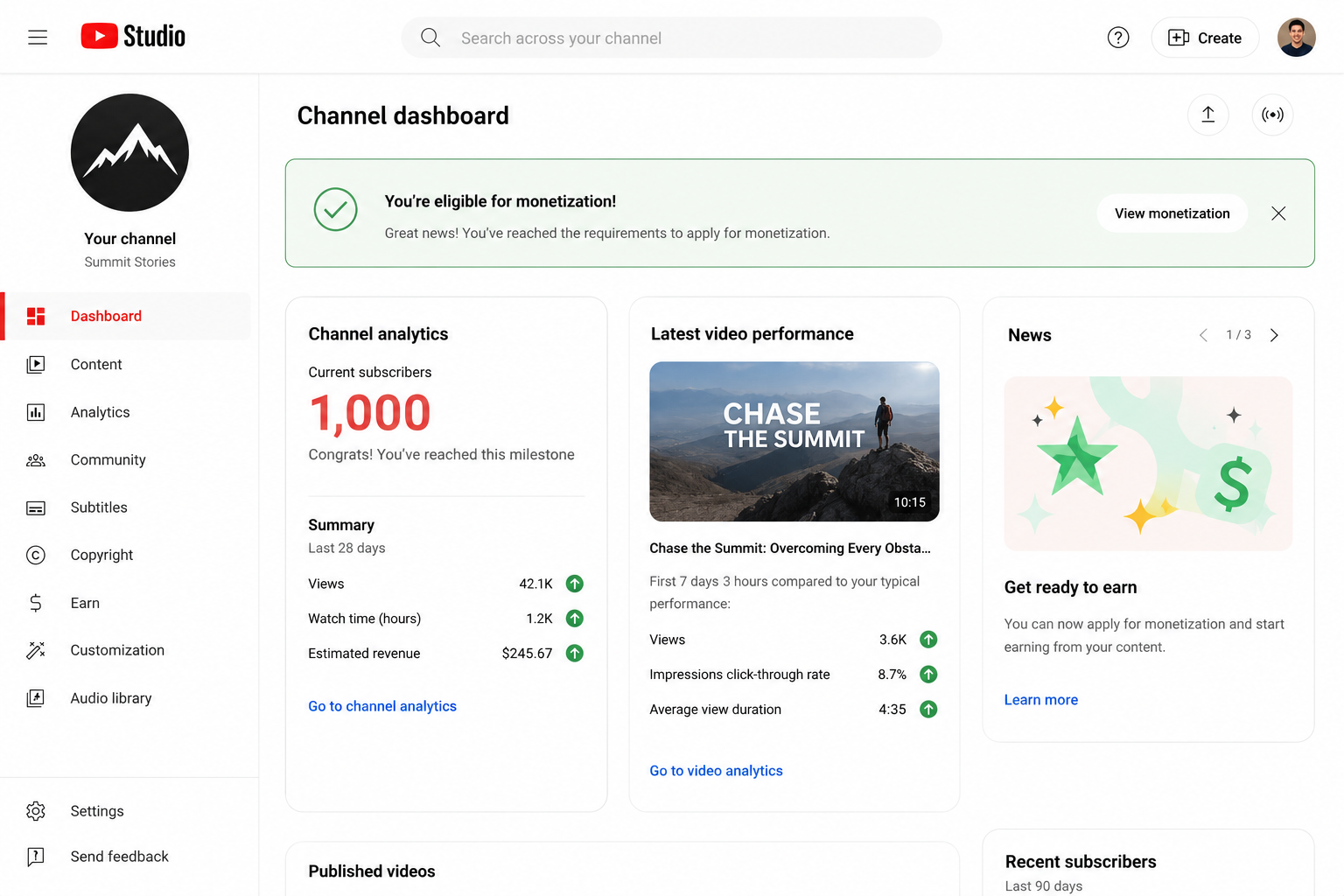
How to Get Your First 1,000 Subscribers on YouTube in 2026 (Step by Step)
If you're searching how to get 1000 subscribers on YouTube, you're chasing the milestone every new creator dreams about. It's the point where YouTube starts taking your channel seriously, where monetization becomes possible, and where your content finally begins reaching audiences beyond friends and family.
The good news? Getting your first 1,000 subscribers in 2026 is still achievable.
The bad news? Most creators approach it the wrong way.
Many beginners focus on uploading more videos, buying expensive gear, or copying viral creators. In reality, subscriber growth comes from understanding how YouTube evaluates content and giving the platform consistent signals that your videos deserve wider distribution.
This guide walks through the exact process successful creators use to reach their first 1,000 subscribers.
Quick Answer
To get your first 1,000 subscribers on YouTube in 2026, choose a focused niche, research rising keywords, create compelling titles and thumbnails, improve audience retention, publish consistently for at least three months, and build relationships with your early viewers. Most channels reach 1,000 subscribers between 25 and 60 uploads when these fundamentals are applied consistently.
Why Are the First 1,000 YouTube Subscribers the Hardest?
The first 1,000 subscribers are difficult because YouTube doesn't yet trust your channel.
Every video you publish enters a testing phase. YouTube shows it to a small audience and measures:
- Click-through rate (CTR)
- Watch time
- Audience retention
- Engagement signals
- Returning viewers
If those metrics are strong, the platform expands distribution. If they're weak, the video stops spreading.
Established channels already have an audience that provides those signals immediately. New creators start from zero.
That's why many channels feel stuck for months before suddenly experiencing growth. The algorithm needs enough data to understand who enjoys your content and when to recommend it.
The goal isn't to convince millions of viewers. The goal is to consistently convince the first few hundred.
How Do You Actually Get Your First 1,000 Subscribers on YouTube?
Step 1: Choose a Niche You Can Sustain
Most beginner channels fail because they're too broad.
A channel that uploads gaming, fitness, productivity, travel, and AI videos sends confusing signals to YouTube. The algorithm struggles to identify the ideal audience.
Instead, focus on one niche.
Good examples:
- Budget tech reviews
- Beginner fitness for busy professionals
- AI tools for creators
- Freelancing tutorials
Too broad:
- Technology
- Health
- Business
- Lifestyle
A simple test: Can you write down 20 video ideas right now? If not, the niche may be too narrow. Can you explain who the channel is for in one sentence? If not, the niche may be too broad.
The sweet spot is a niche specific enough for topical authority but broad enough to support dozens of videos.
Step 2: Research Keywords Before Recording
Many creators record a video first and think about SEO later. The highest-growth channels do the opposite — they identify demand before creating content.
Instead of targeting "How to Make Money Online," try "How to Make Money with AI Editing Services." The second keyword has less competition and attracts a more targeted audience.
Before recording your next video, use the YouSEO Keyword Generator to find rising search opportunities with real search demand. It surfaces low-competition topics your niche audience is actively searching for — before you waste time recording content nobody will find.
When researching ideas, focus on:
- Search demand
- Audience pain points
- Topic relevance
- Content gaps
A single well-researched video can outperform ten random uploads.
Step 3: Create Titles People Actually Want to Click
Titles are advertisements. Your video could be incredible, but nobody will discover that if they never click.
Weak title: "How I Grew My Channel"
Better title: "How I Gained 1,000 Subscribers in 90 Days"
The second title creates specificity, curiosity, and a clear outcome.
Strong YouTube titles often include numbers, timeframes, unexpected results, contrarian opinions, or curiosity gaps. Examples:
- I Posted Daily for 30 Days — Here's What Happened
- The YouTube Strategy Nobody Talks About
- Why Small Channels Fail Before 1,000 Subscribers
- I Tested 10 Thumbnail Styles — One Doubled My CTR
Before publishing, generate multiple title variations and compare them. The YouSEO Title Generator is built specifically for this — it creates high-CTR title options based on your topic so you can test variations before going live. A title improvement alone can double your click-through rate.
Step 4: Design Thumbnails That Stop the Scroll
Titles get attention. Thumbnails get clicks.
Most beginners make one of two mistakes: overcrowded thumbnails or generic thumbnails. The best thumbnails communicate a single idea instantly. A viewer should understand the concept within one second.
Focus on:
- High contrast
- One focal point
- Minimal text
- Emotional expressions
- Clear visual hierarchy
When evaluating thumbnails, ask: Would this stand out among ten competing videos? If the answer is no, redesign it.
Once you've created a thumbnail, test it with the YouSEO Thumbnail Click Score before publishing. It analyzes your thumbnail against CTR benchmarks so you know whether to publish or iterate. Even a small improvement in CTR can create significant growth over time.
Step 5: Hook Viewers Immediately
YouTube cares about retention. Retention starts in the first 30 seconds.
Most creators lose viewers because they begin with long intros, greetings, channel branding, or unnecessary context. Viewers clicked because they want an answer — give them one immediately.
Weak opening: "Hey guys, welcome back to my channel..."
Strong opening: "Most creators never reach 1,000 subscribers because they make this mistake."
The second opening creates curiosity and encourages continued viewing. Effective hooks include surprising statistics, bold claims, contrarian opinions, immediate outcomes, and open loops. The first sentence should be the strongest sentence in the entire video.
Step 6: Build a Consistent Publishing Schedule
Consistency matters because YouTube rewards reliability. You don't need daily uploads — you need sustainable uploads.
For most creators, one long-form video per week plus two to three Shorts per week is enough.
A predictable schedule helps build audience expectations, generate more data for the algorithm, and improve your content creation skills over time.
Most channels quit too early. They upload five videos, see little traction, and stop. The creators who reach 1,000 subscribers are usually the ones who continue publishing long enough for improvement to compound.
Treat the first 12 uploads as training. Treat the next 12 as optimization. Growth often arrives after that.
Step 7: Engage With Your Early Viewers
This step gets overlooked, but early engagement has an outsized impact on your channel's trajectory.
Reply to every comment in your first 100 videos. Ask a question at the end of each video to invite responses. When viewers feel heard, they're far more likely to subscribe, return, and share your content with others.
YouTube's algorithm factors in engagement velocity — how quickly a video collects likes, comments, and shares after publishing. A small engaged community can dramatically accelerate distribution during the critical first 24–48 hours after upload.
Community building also gives you direct insight into what your audience actually wants. The questions and comments on your videos are free content research.
Which YouTube Analytics Matter Before 1,000 Subscribers?
Many creators obsess over views. Views matter, but they're not the best growth indicator.
Click-Through Rate (CTR) measures how often people click after seeing your video. General benchmarks: below 3% needs improvement, 4–6% is average, 7–10% is strong, and above 10% is excellent. Low CTR usually means title or thumbnail issues.
Audience Retention measures how long viewers stay. Pay attention to the first 30 seconds, first 60 seconds, and average percentage viewed. Sharp drops often indicate weak hooks.
Watch Time remains one of YouTube's strongest ranking signals. A 10-minute video watched for 6 minutes often outperforms a 10-minute video watched for 2 minutes. Always prioritize value over length.
Returning Viewers indicate audience loyalty. A growing number suggests people want more content from you — often one of the earliest indicators of future channel growth.
Subscribers Gained Per Video reveals what your audience wants. Identify which videos generate the most subscribers and create more content around those successful themes.
Common Mistakes That Keep Channels Below 1,000 Subscribers
Uploading without a strategy. Random uploads produce random results. Every video should support your niche and audience.
Copying large creators. Large channels succeed because they already have audiences. What works for them often fails for beginners. Instead of copying content, study structure and presentation.
Ignoring packaging. Your title, thumbnail, and hook determine whether people click and watch. Even great content fails without strong packaging.
Chasing trends outside your niche. Jumping on viral trends that don't fit your channel confuses both the algorithm and your audience. Occasional relevance is fine, but your core content should stay focused.
Quitting too early. Most creators stop before reaching meaningful data. The first 20 uploads are often research. The first 50 are often optimization. Success frequently arrives after persistence.
Should You Use YouTube Shorts to Reach 1,000 Subscribers?
Yes, but strategically.
Shorts can accelerate subscriber growth because they receive massive distribution. However, Shorts subscribers don't always become long-form viewers.
The best approach: one long-form video weekly, plus multiple Shorts supporting that topic.
Example:
Long-form: "How I Got My First 1,000 Subscribers"
Shorts:
- Biggest mistake new creators make
- Best thumbnail tip
- How to improve CTR
This creates multiple discovery paths into your channel. Think of Shorts as audience acquisition and long-form content as audience retention.
A Realistic Timeline to Reach 1,000 Subscribers
Every niche is different, but most successful channels follow a similar pattern.
Months 1–2: Learning fundamentals, low views, testing content.
Months 3–4: Improved CTR, better retention, initial subscriber momentum.
Months 5–8: Breakout videos, consistent audience growth, increased recommendations.
Months 6–15: 1,000 subscriber milestone.
The timeline varies, but the process is consistent. The creators who win are usually not the most talented — they're the most consistent.
First 1,000 Subscribers Checklist
Before publishing your next video:
- ✓ One clear niche
- ✓ Target keyword researched
- ✓ Strong title created
- ✓ Thumbnail designed for CTR
- ✓ Hook optimized
- ✓ Value delivered quickly
- ✓ Clear call-to-action included
- ✓ Analytics reviewed
- ✓ Upload schedule maintained
- ✓ Audience comments answered
Complete these consistently and your growth odds improve dramatically.
Start Working Toward Your First 1,000 Subscribers Today
The path to 1,000 subscribers isn't a secret. It's a collection of small decisions repeated consistently.
Choose a niche. Research audience demand. Create stronger titles. Design better thumbnails. Improve retention. Publish regularly. Learn from analytics.
Most importantly, keep going.
Your first viral video could be upload number 5, 25, or 55. The only creators guaranteed to fail are the ones who stop publishing before they discover what works.
If you want to improve your chances faster, use the YouSEO Title Generator to create higher-CTR titles, test your thumbnail with Thumbnail Click Score, and find rising search opportunities with the Keyword Generator before recording your next video.
Your first 1,000 subscribers starts with the next upload.