
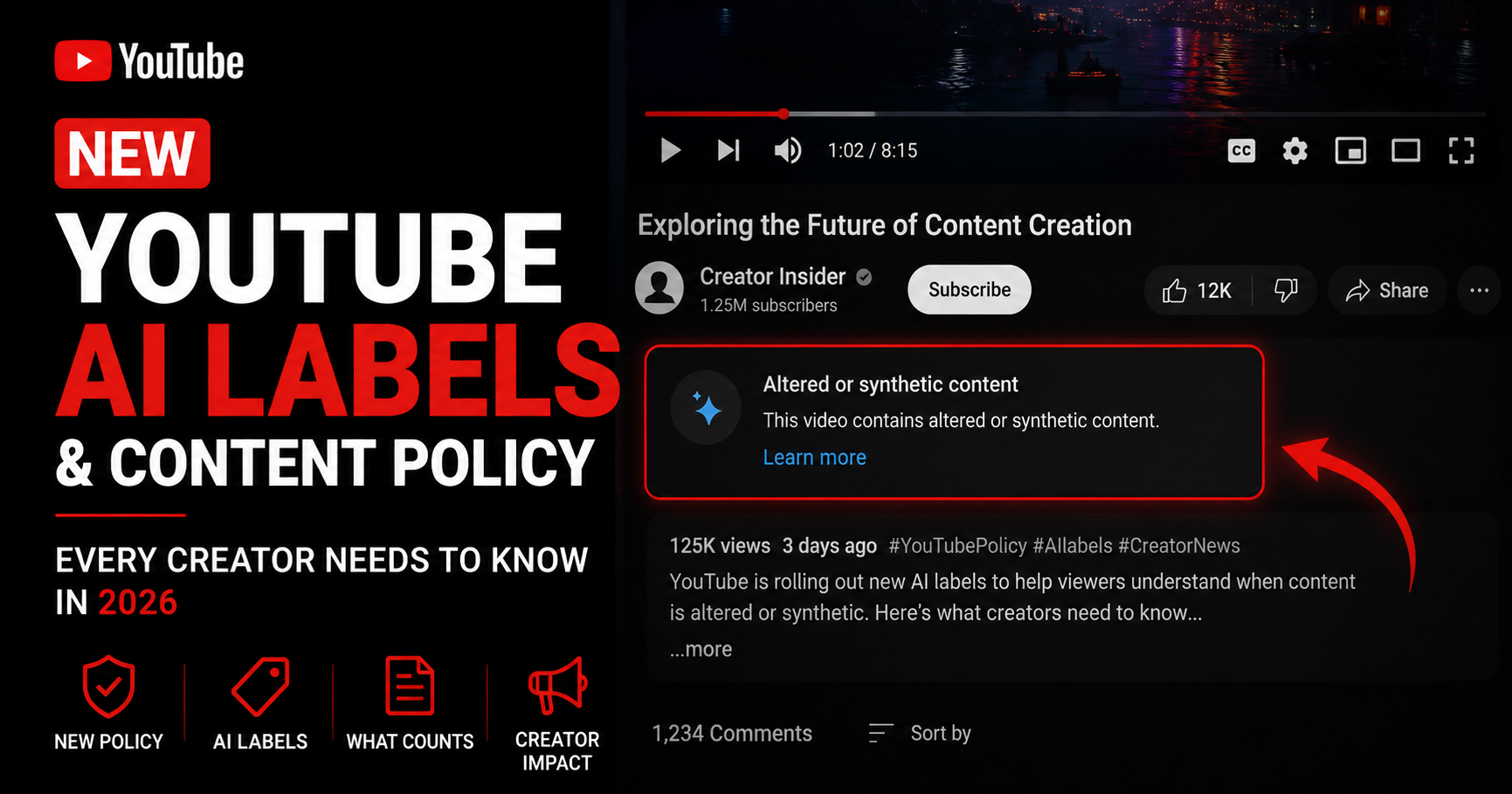
YouTube Now Auto-Labels AI Videos in 2026 - Will It Kill Your Views & Revenue?
If you've spent the last few weeks worried that YouTube AI labels are about to wreck your views or get you demonetized, you're not alone. The platform's late-May 2026 announcement triggered a wave of panic across creator communities - and most of it isn't backed by what YouTube actually said. The honest version is calmer than the headlines suggest, but not nothing: a few things genuinely changed, and ignoring them would be a mistake.
This guide walks through what YouTube actually announced on May 27, 2026, who it affects, the honest answer to the two biggest fears creators are searching, and the action plan that matters regardless of how the rollout plays out.
Quick Answer
YouTube's new auto-labels do NOT directly cut your views or demonetize your channel. The label by itself is not an algorithmic penalty or a monetization flag. What can move performance is viewer behavior in response to the label - click-through rate, watch time, and trust - and how well your title, thumbnail, and metadata still earn the click. Disclose proactively; sharpen your metadata.
What Actually Changed in 2026?
YouTube announced two related updates on May 27, 2026, in an official blog post titled "Improving AI labels for viewers and creators." The rollout begins gradually starting May 2026, and full deployment is expected over subsequent months. Two practical things changed:
- Label placement is now far more prominent. For long-form videos, the AI disclosure label now appears directly below the video player, above the description. For Shorts, it appears as an overlay on the video itself. This replaces the older description-only placement for photorealistic AI content.
- YouTube now auto-detects AI content even without disclosure. Internal detection signals identify videos containing "significant photorealistic AI" and automatically apply the label, even if the creator didn't disclose. Self-disclosure is still required by policy; auto-detection supplements that obligation, it doesn't replace it.
Labels are permanent for content made with YouTube's own AI tools (Veo, Dream Screen) or carrying C2PA metadata indicating fully generative AI. For other content, creators can contest or update an incorrect label through YouTube Studio - detection is probabilistic, so false positives are possible.
Who Does This Affect - and Who Does It Mostly Not?
The prominent label applies to videos containing photorealistic or meaningfully AI-altered or generated content: AI-generated humans, synthetic faces or voices presented as real, deepfake-style face swaps, AI-generated realistic event footage, and AI-cloned voices of real people.
Content that generally does NOT trigger the prominent label includes obvious animation, cartoon-style AI imagery, minor color or lighting adjustments, AI captions, and many faceless-channel formats where AI voiceover plays over royalty-free stock footage with no realistic AI imagery. Self-disclosure remains a policy requirement for all meaningfully altered realistic content - auto-detection supplements that obligation, not excuses it.
Will the YouTube AI Label Hurt My Views?
Directly, no. YouTube has been explicit: the label itself does not change recommendations, search ranking, or distribution. It's a viewer-information signal, not an algorithmic penalty.
Indirectly, viewer response to the label can affect click-through rate, average view duration, and subscribe rate - and those signals do feed back into how the algorithm distributes content. The effect varies by niche:
- News, education, history, and explainer niches: transparency often works in your favor. Viewers who feel respected by clear disclosure trust the content more.
- Entertainment and creative storytelling: neutral effect when the AI use is clearly part of the creative pitch.
- Faceless AI-voiceover channels or realistic AI tutorials: most exposure to behavior shift, especially if your audience didn't realize the channel uses AI heavily.
Will I Get Demonetized?
The label itself is not demonetization. Auto-applying a disclosure tag does not change your YouTube Partner Program status, ad eligibility, or revenue share.
What actually risks monetization follows existing YPP policy, not the label: undisclosed realistic AI content (a policy violation), reused or mass-produced content lacking original commentary or transformation, and content that fails YouTube's helpfulness or originality standards. Honest disclosure protects you. The creators most at risk are those who built channels around hiding AI rather than working with it transparently.
If you got an auto-applied label you believe is incorrect, dispute it via YouTube Studio. Don't strip metadata, re-encode to dodge detection, or delete and reupload - those tactics draw more scrutiny, not less.
What Are the EU AI Act and California SB 942 Doing in 2026?
YouTube's policy doesn't exist in a vacuum. Two major laws reinforce AI transparency globally in 2026:
- EU AI Act - full applicability from August 2, 2026. Article 50 transparency obligations require generative AI providers to label AI-generated content and inform users when interacting with AI systems. Penalties for non-compliance can reach up to €15 million. The Act applies to providers serving the EU market, wherever they're based.
- California SB 942 (the AI Transparency Act): imposes similar AI-disclosure requirements on generative AI providers serving California users.
This is informational, not legal advice. Regulatory frameworks evolve rapidly, and obligations depend on your role (creator vs. tool provider), audience geography, and content type. Consult a qualified legal professional for compliance guidance specific to your channel.
What Should You Do Right Now?
The label is coming either way. Here's the realistic action plan:
1. Disclose proactively in YouTube Studio. Self-disclosure costs nothing and protects you from policy-violation risk far more than auto-detection ever would. Use the upload-time disclosure for any realistic or meaningfully altered AI content.
2. Register for likeness detection if your face or voice gets impersonated. YouTube expanded its likeness-detection program in 2026; mid-sized creators and educators are increasingly targeted by deepfakes, not just celebrities.
3. Don't try to dodge detection. Stripping C2PA metadata, re-encoding to obscure AI signatures, or constantly deleting and reuploading flagged content tends to attract more policy scrutiny, not less. Transparency is the lower-risk path in 2026 and beyond.
4. Double down on titles, thumbnails, descriptions, and tags. The label is coming either way - what you control is whether your video still earns the click and holds the viewer. Scan every upload with the YouSEO YouTube video SEO checker to make sure your metadata is doing its job. For a step-by-step walkthrough, see how to check your YouTube video's SEO score; for the benchmark ranges, see what is a good YouTube SEO score.
5. Audit existing AI-using uploads. Check your last 20-30 videos that used realistic AI. Confirm disclosure was applied at upload. If the new prominent label has been auto-applied, decide whether the existing title and thumbnail still earn the click in that new context - and update them if not.
If your AI content is Shorts-heavy, the same logic applies to Shorts metadata - see YouTube Shorts SEO for the Shorts-specific ranking factors. And launch each upload when your audience is online with help from best time to post on YouTube.
A Tale of Two AI-Using Channels: How the Label Plays Out
Consider two channels both producing AI-generated history-explainer videos in 2026.
Channel A panics, changes nothing about discoverability. The auto-label appears. Thumbnails still read like real photos; viewers click, see the prominent AI label, feel surprised, and CTR drops. The creator blames the label.
Channel B discloses cleanly at upload, updates thumbnails to signal "AI history explainer," adds transparency cues like "AI-animated" to titles. The label appears below the player as context, not surprise. CTR stays steady; watch time actually rises because the audience trusts the framing. Same content, same AI use, dramatically different performance - and the difference came from how the channel handled the label, not whether the label was there.
Frequently Asked Questions About YouTube AI Labels
Does the YouTube AI label affect search ranking or recommendations?
No, not directly. YouTube has been explicit that the label is a viewer-information signal, not an algorithmic input. Indirectly, viewer behavior in response (click-through rate, watch time, trust) can shift performance - but the label itself isn't a ranking penalty.
Will I be demonetized just because of the AI label?
No. The label is not demonetization. It does not change your YouTube Partner Program status or ad eligibility. What can affect monetization is unrelated to the label: undisclosed realistic AI content (policy violation), reused or mass-produced content, or other YPP rule violations. Honest disclosure protects you.
Can I remove the AI label from my video?
Sometimes. You can contest or update an auto-applied label via YouTube Studio if detection was incorrect. However, labels are permanent for content created with YouTube's AI tools (Veo, Dream Screen) or content carrying C2PA metadata indicating fully generative AI - those can't be removed by appeal.
What counts as "significant photorealistic AI" on YouTube?
Realistic AI-generated humans, synthetic faces or voices presented as real, deepfake-style face swaps, AI-generated event footage, and AI-cloned voices of real people. Animation, obvious cartoon-style AI imagery, AI-assisted editing or color grading, and AI voiceover over stock footage generally don't trigger the prominent label.
Do I still need to self-disclose AI content if YouTube auto-detects it?
Yes. Self-disclosure remains required by policy for all realistic or meaningfully altered AI content. Auto-detection supplements that obligation - it doesn't replace it. Skipping disclosure when policy requires it is a policy violation regardless of whether auto-detection catches the content.
Does the AI label apply to YouTube Shorts?
Yes. For Shorts, the AI label appears as an overlay directly on the video. The same auto-detection logic applies - significant photorealistic AI without disclosure triggers an automatic label, contestable via YouTube Studio.
How does the EU AI Act affect YouTube creators?
The EU AI Act's Article 50 transparency obligations apply from August 2, 2026, and require AI providers and deployers to label AI-generated or manipulated content for users in the EU. Creators using generative AI for EU audiences should ensure clear disclosure - both via YouTube's own tools and any other transparency requirements. Consult a legal professional for specific compliance guidance.
Bottom Line: Don't Panic, but Do Adapt
YouTube AI labels in 2026 are real, more visible, and now auto-applied. They are not, by themselves, an algorithmic punishment or a monetization flag. The variables you control - disclosure, transparency, and how well your titles, thumbnails, descriptions, and tags earn the click - matter more than ever now.
The label is coming either way - make every title, tag, and description earn the click with the YouSEO YouTube video SEO checker. Check and fix your metadata so viewer response works for you. Try YouSEO free today.