
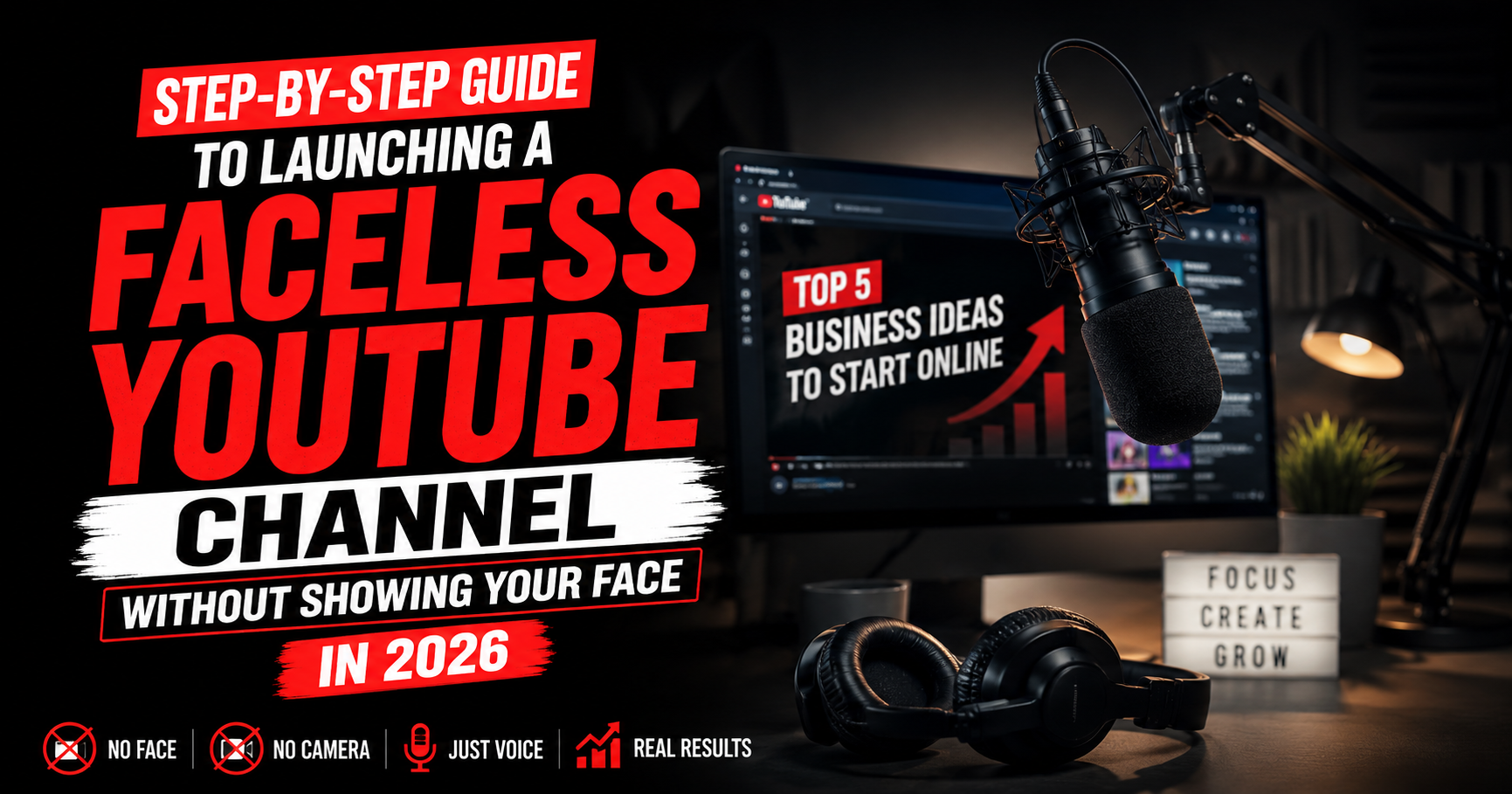
How to Start a Faceless YouTube Channel in 2026 (No Camera Needed)
If you're searching for how to start a faceless YouTube channel, you're not alone. Thousands of creators want the income and reach of YouTube without ever appearing on camera. The good news: faceless channels grow and monetize just as well as on-camera ones in 2026 - sometimes better. The honest caveat: they only work when the underlying content is genuinely original and value-adding.
This guide walks you through what a faceless channel actually is, the six main faceless formats that work today, the niches that perform best, and a clear step-by-step setup. Plus the honest truth most faceless guides skip: faceless does not mean effortless.
Quick Answer
To start a faceless YouTube channel in 2026: pick a niche with proven search demand, choose a format (voiceover + stock footage, screen recording, animation, AI narration, slideshow, or relaxation/music), write an original script, record or generate a voiceover, source stock footage and visuals, edit, and create clickable titles and thumbnails. Originality matters - YouTube won't monetize reused or mass-produced content.
Why Do Faceless YouTube Channels Actually Work?
Faceless channels work because YouTube viewers don't actually care about your face - they care about the value, the information, the entertainment, or the experience your content delivers. A great voiceover with strong visuals can hold attention better than a poorly framed on-camera shot. Many of YouTube's biggest channels in finance, history, sleep, science, and tutorials have never shown a creator's face.
Faceless also lowers the barrier to consistency - no makeup, no studio lighting, no on-camera anxiety. You can record a voiceover in your closet at midnight if that's when the writing's good. For many creators, removing the camera requirement is what makes daily uploads finally possible.
What Is a Faceless YouTube Channel, Really?
A faceless YouTube channel is any channel where the creator never appears on screen as the primary visual focus. The visuals come from stock footage, screen recordings, animation, slideshows, b-roll, or generated imagery - paired with a voiceover, on-screen text, or background music. Some faceless creators show their hands, silhouettes, or a brand logo. Others remain fully anonymous. The defining trait isn't anonymity - it's that the content itself, not the creator's face, carries the channel.
What Are the Main Faceless YouTube Content Formats?
Six faceless formats consistently perform on YouTube in 2026:
- Voiceover over stock footage: the most common faceless format. A scripted voiceover paired with relevant b-roll. Works for educational, finance, history, science, and storytelling channels.
- Screen recordings and tutorials: perfect for software tutorials, coding, design, productivity tools, and tech reviews. Your screen IS the content.
- Animation and whiteboard: 2D animated videos or hand-drawn whiteboard explainers. Higher production cost but excellent for explaining complex topics in education and business.
- Text-to-speech or AI narration: AI-generated voices reading scripts. Works for low-cost rapid production but increasingly penalized by YouTube if the content lacks transformation or original commentary.
- Slideshow and documentary: static images, infographics, and stills paced like a documentary. Strong for history, ranked-list, biographical, and educational content.
- Relaxation, ambient, and music: sleep videos, study music, white noise, and lo-fi compilations. Long-watch-time formats with strong AdSense potential.
Which YouTube Niches Work Best for Faceless Channels?
Some niches lend themselves naturally to faceless production because the content doesn't require the creator's personal presence:
- Personal finance and investing: explanatory voiceover content with charts and stock footage.
- History and documentary: narrated storytelling with archival imagery.
- Tech tutorials and software reviews: screen recordings deliver the value directly.
- Education and how-to: from coding to language learning to academic tutorials.
- Relaxation, sleep, and meditation: ambient visuals with calming voiceover or music.
- Top 10 lists, biographies, and case studies: evergreen formats with consistent search demand.
For a deeper breakdown of profit potential and CPM by niche, see our companion guide on best faceless YouTube niche ideas for 2026.
What's the Step-by-Step Setup to Start a Faceless YouTube Channel?
Follow this seven-step workflow to launch your first faceless channel:
1. Pick a niche with real search demand. Don't choose based on what looks profitable in someone else's case study. Use the YouSEO Keyword Research tool to find faceless-friendly niches with consistent search volume and manageable competition.
2. Choose your faceless format. Pick one format from the six above and commit to it for at least 20 videos. Format consistency trains both your audience and the algorithm.
3. Write a strong, original script. The script carries the entire video without your on-camera presence to fall back on. Open with a hook in the first 5 seconds, deliver clear value, and end with a clear takeaway. Write it yourself - script quality separates ranking faceless channels from generic ones.
4. Record or generate the voiceover. A cheap USB microphone in a quiet room is enough to start. If using AI narration, layer your own commentary and transformation on top - pure AI voiceover with reused scripts won't pass YouTube's monetization originality check.
5. Source stock footage, b-roll, and visuals. Pexels, Pixabay, and Storyblocks offer free or affordable royalty-free footage. Match visuals to script beats - don't let the same clip linger more than 5-7 seconds without a cut.
6. Edit with pacing and rhythm. Cut tightly. Add captions for the 80%+ of viewers watching without sound. Add background music at low volume for mood. Keep dead air minimal.
7. Design clickable titles and thumbnails. Thumbnails matter MORE for faceless channels - without your face as a visual anchor, the thumbnail needs to do all the storytelling. Use high contrast colors, large legible text, and a clear focal point that previews the video's payoff.
Why "Faceless" Does NOT Mean "Effortless"
The most common faceless channel mistake is treating it as a shortcut. YouTube's monetization rules require original, value-adding content. Reused public-domain footage with AI voiceover reading a Wikipedia article won't pass review. Channels mass-producing low-effort content using identical templates are routinely demonetized in 2026.
What works: original scripts, your own analysis or commentary, structured editing, well-researched information, and a clear point of view. "Faceless" describes the format - it does not lower the originality bar. The most successful faceless channels invest as much in script research, voiceover quality, and edit polish as on-camera creators invest in production setup.
How Should Brand-New and Scaling Creators Approach Faceless Differently?
For absolute beginners launching their first faceless channel
Start with the simplest faceless format that fits your niche - usually voiceover over stock footage or screen recording. Don't invest in animation or complex production until you've shipped 20 uploads. Commit to one niche and one format for the first 50 videos. The early channel is for learning what works for your specific audience, not perfecting production. Quality of script and consistency of uploads matter more than visual polish at this stage.
For creators scaling a faceless channel into a batched operation
Once you've validated your niche and format, build a repeatable production pipeline. Batch script-writing days, voiceover days, and editing days. Many established faceless creators outsource editing or footage sourcing while keeping script and narration in-house. Use YouSEO Channel Analytics to identify which video types pull highest retention and double down on those - at scale, focus pays more than variety.
Frequently Asked Questions About Faceless YouTube Channels
Can you really make money with a faceless YouTube channel?
Yes - many faceless channels earn full-time income through AdSense, sponsorships, and affiliates. The key is original content with real value. YouTube doesn't differentiate between faceless and on-camera channels for monetization, as long as the content meets originality and helpfulness standards.
Is AI voiceover allowed on YouTube?
AI voiceover is allowed, but channels using AI narration with mass-produced templated content or no original commentary are increasingly demonetized. Use AI as a tool, not a replacement for original work. AI voice + original script + your own research + thoughtful editing = acceptable; AI voice reading reused content = at risk.
How long does it take to grow a faceless YouTube channel?
Most consistent faceless creators reach YPP eligibility (1,000 subs + 4,000 watch hours) within 6-12 months when posting 2-3 videos weekly. Tutorial and educational niches tend to grow faster because they have steady search demand; entertainment niches grow slower without trend timing.
Do I need expensive equipment for a faceless YouTube channel?
No. A USB microphone (under $100), free editing software (DaVinci Resolve or CapCut), and a laptop are enough to start. Stock footage from Pexels and Pixabay is free. Production budget matters far less than script quality and consistency.
What faceless niche is most profitable?
Personal finance, investing, and B2B tutorials tend to have the highest CPMs ($10-$30+ RPM) in faceless formats. Sleep, meditation, and ambient music earn lower CPMs but huge total watch time. Pick the niche where you have genuine knowledge - profitability follows expertise more than topic choice alone.
How Do You Launch Your First Faceless YouTube Channel This Week?
Starting a faceless YouTube channel in 2026 isn't about avoiding the camera - it's about choosing a sustainable production format that lets you ship consistent original content. Pick a niche with real search demand, commit to one format, write your own scripts, and treat the work with the same rigor an on-camera creator would. Faceless removes the camera, not the creator. The most successful faceless channels are the ones run by people who treat their channel as a real publication.
Find a profitable faceless niche and topics with real demand using the YouSEO Keyword Research tool. Track what's working and double down with Channel Analytics. Try YouSEO free today.