
How to Find Trending YouTube Video Ideas Before They Peak
Most creators discover trending YouTube video ideas the wrong way. You see a topic exploding across your home feed, race to film, publish, and watch it die - because by the time a trend is obvious to everyone, the early movers have already captured the distribution and your version competes for scraps.
The skill that separates growing channels from stuck ones isn't trend-following - it's trend-spotting while the wave is still climbing. This guide breaks down the trend lifecycle, the free signals that surface rising topics before they go mainstream, and the workflow that turns those signals into a published video before your niche floods.
Quick Answer
To find trending video ideas before they peak, watch leading signals - YouTube search autocomplete, Google Trends breakouts, cross-platform momentum on TikTok and Reels, competitor outlier videos, and rising views-per-hour in your niche. Validate that demand is still climbing (not flooded). Confirm niche fit, then film and publish within 1-2 weeks. YouSEO's trend tools surface rising topics automatically so you film before saturation instead of after.
Why Do Most Creators Find YouTube Trends Too Late?
Because trends are invisible until they're obvious - and by the time they're obvious, they're saturated. A trend you noticed because it filled your home feed has already been seen by the algorithm thousands of times. The early-mover videos have captured the search ranking, the suggested-video real estate, and the audience curiosity. Your version arrives into a crowded room where viewers have already watched three takes on the same idea.
The fix isn't to give up on trends. It's to learn how to spot demand earlier - when interest is climbing but supply is still thin, before the distribution window closes.
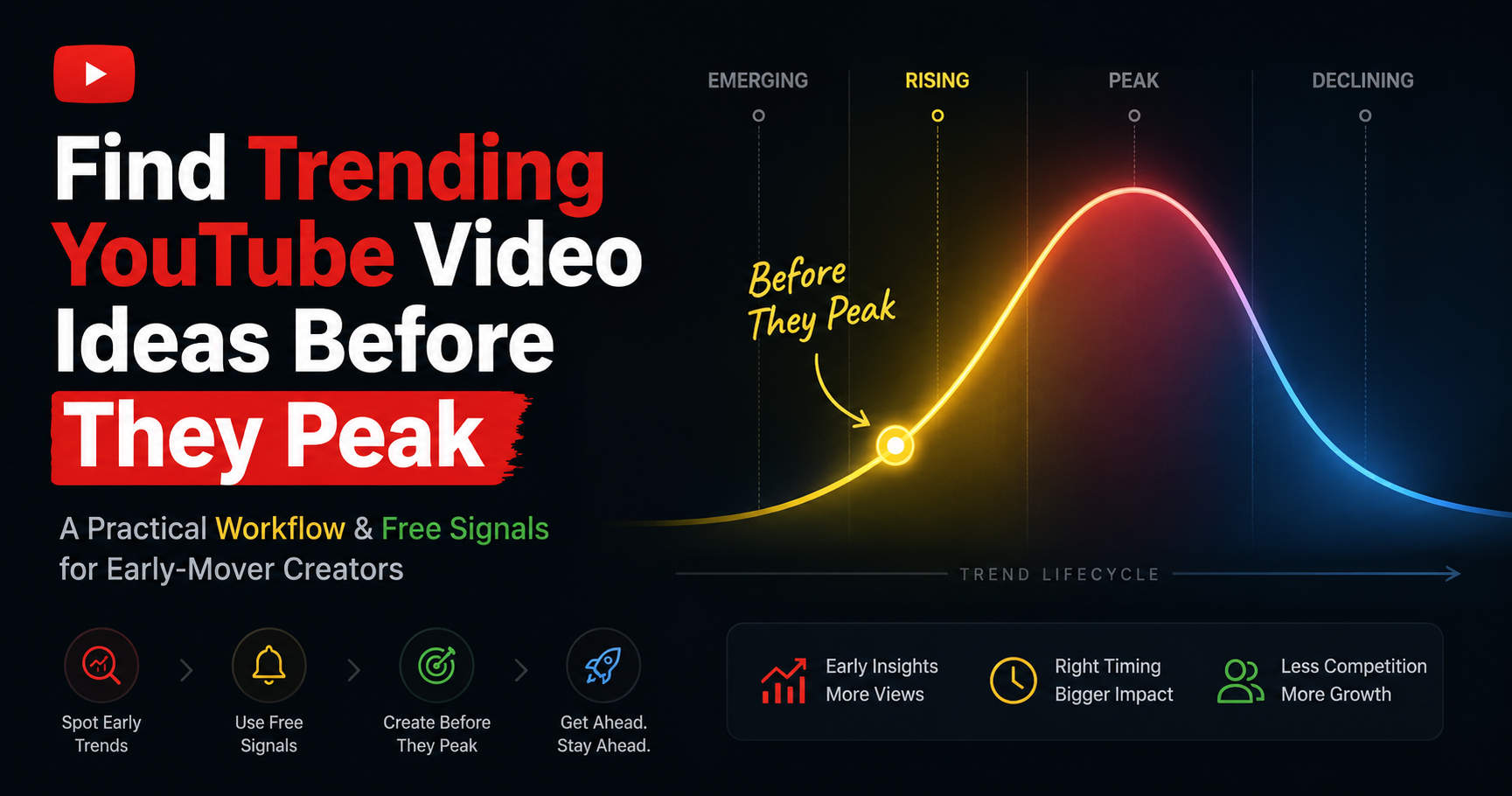
What Does "Before They Peak" Actually Mean? The Trend Lifecycle
Every trend moves through four stages:
- Emerging: a topic appears in search and discussions but volume is small. Most creators miss this - it's still ambiguous.
- Rising: interest is climbing steeply; videos on the topic get unusual views-per-hour. THIS is the sweet spot.
- Peak: everyone's talking about it. Saturation is high. Early-movers already rank.
- Decline: interest fades. New videos earn little because the audience has moved on.
The rising stage is the early-mover window: enough demand to justify the video, not enough competition to bury you. Catching trends rising and publishing within their distribution window is the entire skill.
How Do I Find Trending YouTube Topics? The Free Signals
Top creators monitor multiple signals at once. The more sources you check, the earlier you spot rising demand. Seven reliable free signals:
- YouTube search autocomplete: type partial queries in your niche and watch what YouTube suggests. New phrasings appearing are early-warning signals.
- Google Trends - Rising and Breakout queries: filter by region and 7-30 day windows. Breakout queries are growing fastest. Cross-reference with your niche.
- Cross-platform leading indicators (TikTok, Reels): short-form platforms often run 1-2 weeks ahead of YouTube. A trend rising on TikTok this week is your YouTube opportunity next week.
- Competitor breakout videos: find videos in your niche that massively outperformed a channel's average - outliers signal what's resonating.
- Rising views-per-hour in your niche: recent uploads accumulating views unusually fast means the topic is climbing. Velocity matters more than raw view count.
- Audience comments and requests: your subscribers asking the same question repeatedly is a demand signal exclusive to your channel.
- Predictable seasonal trends: holidays, tax season, back-to-school, fitness January, gift guides Q4 - pre-positioned opportunities you can prepare weeks ahead.
How Do I Know If a Trend Is Still Rising or Already Peaked?
Two questions answer this.
First: is interest still climbing? Check Google Trends - if the line is still moving up over the last 7-30 days, the trend is rising. If it's flat or declining, it's peaked or cooling.
Second: how much supply already exists? Search the topic on YouTube. If the top results are all from the past 3-7 days with high view counts, the early-mover window is closing. If results are sparse or older, demand exists without sufficient supply - your opportunity.
Climbing demand + thin supply = rising trend worth filming. Flat demand + flooded supply = peaked, skip.
From Signal to Video: The Repeatable Workflow
Six steps from spotting a signal to publishing a video that catches the wave:
1. Spot a rising topic. Scan your free signals daily, or use a tool that surfaces them automatically.
2. Validate demand and check saturation. Google Trends shows trajectory; YouTube search shows competition. Both should align before you invest filming time.
3. Confirm niche and audience fit. A rising trend outside your niche brings in viewers who don't subscribe - a vanity-metrics trap.
4. Research keywords and your angle. Use YouTube keyword research to find the high-intent terms your title and description should be built around - and identify the original angle competitors haven't covered.
5. Film fast and publish within the window. Rising trends have shelf lives of days to weeks. Launch when your audience is active - see best time to post on YouTube.
6. Optimize the title and metadata so it gets discovered. Scan with the YouTube video SEO checker to confirm title, description, tags, and thumbnail are aligned. A rising trend with weak metadata still flops.
How YouSEO Speeds This Up
Manually scanning seven signal sources every day takes hours - and you'll still miss most of what's rising in adjacent niches. YouSEO's trend tools surface what's about to blow up automatically, so you spend creative time filming instead of investigative time hunting.
Use Trending Video Ideas for long-form trend surfacing - rising topics across niches with their demand trajectory and competition level scored, so you know whether a trend is still in the rising window before you commit filming time. Use Trending Shorts Topics for Shorts-specific topic surfacing - what's rising in the short-form ecosystem right now in your niche, distinct from the audio-focused signals on YouTube's native Shorts Trends page.
Both tools cut the hunting time from hours per week to minutes per day. Film before your niche floods, instead of after. For more on YouTube's native Shorts audio tool (complementary, not duplicative), see YouTube's Shorts Trends page.
Long-Form vs Shorts Trend-Spotting: What's Different?
Shorts trends move faster - the rising window is typically 1-2 weeks. They lean heavily on audio, formats, and short-form-native ideas (challenges, reactions, hooks). Long-form trends move slower - the rising window can stretch 4-8 weeks. They lean on deeper topics, news cycles, evergreen demand spikes, and content explorations that need 8-15 minutes to deliver value.
Use the right tool for the format you're producing: Trending Video Ideas for long-form discovery, Trending Shorts Topics for short-form. For the metadata side of Shorts specifically, see YouTube Shorts SEO.
A Tale of Two Creators: Early Mover vs Late Arrival
Two cooking channels notice the same rising trend - a viral cooking technique gaining traction in food communities.
Creator A spots the signal on Day 2 (rising stage), validates demand on Google Trends, finds only a handful of small videos on YouTube. They film within 48 hours, publish on Day 4 with a keyword-led title, and ride the rising window. The video accumulates 180,000 views over 14 days - third-best upload of the quarter.
Creator B notices the same trend on Day 18 (post-peak), when their home feed is already saturated. They film, post on Day 22, and watch the video stall at 4,200 views. Same topic, same format, same channel size - completely different outcome. 14 days of timing made the difference.
Frequently Asked Questions About Finding Trending YouTube Topics
How do I find trending topics on YouTube?
Monitor multiple signals: YouTube search autocomplete, Google Trends rising and breakout queries, cross-platform momentum on TikTok and Reels, competitor outlier videos, rising views-per-hour in your niche, audience comments, and seasonal patterns. Tools like YouSEO's Trending Video Ideas surface rising topics automatically.
How do I know if a trend is still rising or already peaked?
Two checks: (1) is interest still climbing on Google Trends over the last 7-30 days? (2) how much YouTube competition already exists for the topic? Rising demand + thin supply means you're still inside the window. Flat demand or flooded supply means you're too late.
How fast do I need to publish after spotting a rising trend?
Shorts trends: within 1-2 weeks of the rising signal. Long-form trends: within 4-8 weeks. Earlier is better - the early-mover advantage compounds because YouTube's algorithm preferentially distributes the videos that establish authority on a topic first.
Do trending topics work for small channels?
Yes - often better than for large channels. Small channels have less established audience expectation, so a rising-trend video can attract entirely new viewers who otherwise wouldn't find the channel. Trends are one of the most reliable discovery accelerators for channels under 10,000 subscribers.
How is this different from just copying viral videos?
Copying viral videos targets the peak/decline stages - you arrive when distribution has already been captured. Trend-spotting targets the rising stage, where demand exists but competition is thin. Trend-spotting also requires niche fit and original angle; copying ignores both and gets buried.
Long-form vs Shorts trends - which should I focus on?
Whichever format you're already producing. Shorts trends move faster and lean on audio; long-form trends move slower and lean on deeper topic exploration. Use Trending Video Ideas for long-form and Trending Shorts Topics for Shorts, matched to your format.
Stop Finding Trends Too Late
The skill of catching trends rising - not peaked - separates channels that grow consistently from channels that hit publish and hope. Watch your signals, validate demand and saturation, confirm niche fit, then publish before the window closes.
Stop finding trends too late - see what's about to blow up with YouSEO's Trending Video Ideas (long-form) and Trending Shorts Topics. Film before your niche floods, then optimize so it gets discovered. Try YouSEO free today.