
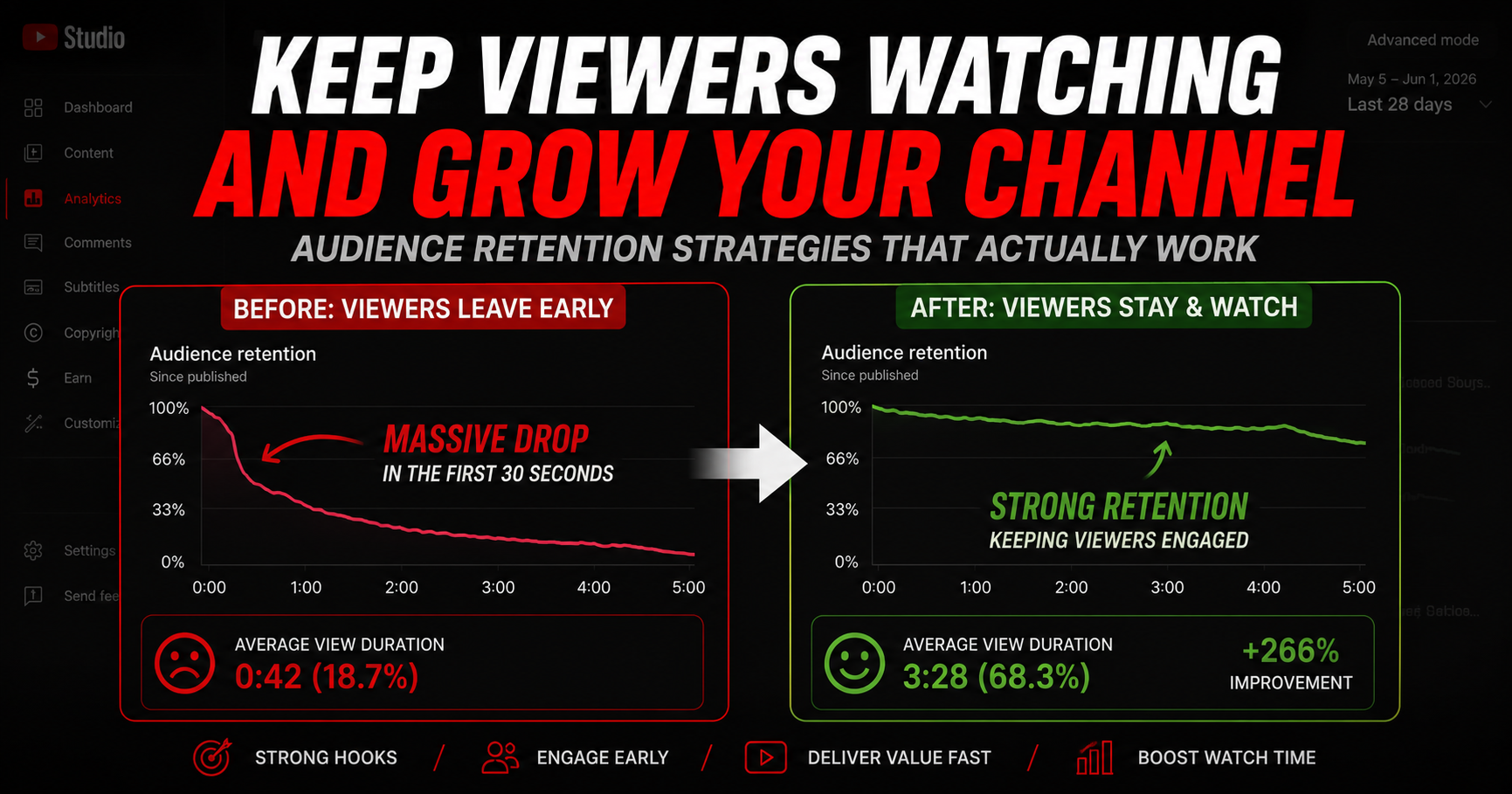
How to Stop Viewers Clicking Away in the First 30 Seconds
If you've been searching how to improve audience retention on YouTube, you already know the brutal truth: most viewers decide whether to keep watching in the first 30 seconds. Lose them there, and the algorithm reads your video as a content failure no matter how good the rest is.
The opening is the most important window in any YouTube video. Average view duration in the first 30 seconds shapes how widely the algorithm distributes your upload - and most channels lose 30-50% of viewers in that exact stretch. This guide walks you through what's failing and exactly how to fix it.
Quick Answer
To improve audience retention on YouTube, cut every second of slow intros, logos, and "welcome back" preambles. Deliver on the title and thumbnail promise within the first 5 seconds. Open with a question, a bold claim, or a preview of the payoff. Use tight pacing and re-hook every 60-90 seconds. Read your retention graph to find exactly where viewers drop off.
Why Do the First 30 Seconds Decide a YouTube Video's Fate?
The first 30 seconds are the most important window because YouTube uses early retention to predict whether your video will hold a wider audience. If average view duration drops below roughly 70% in that opening, the algorithm reads it as viewer dissatisfaction and stops widening distribution. Early retention is the single signal that shapes how far your upload travels.
Most creators lose viewers in this window because they treat the opening like a podcast intro - greeting, topic preview, channel branding. Every one of those phrases is a permission slip for the viewer to leave. The fix isn't more content. It's restructuring the first 30 seconds around one job: stop the viewer from clicking away long enough to commit to the video.
How Do You Build a Hook That Holds Attention?
A strong opening hook does five things at once - and most failing videos do none of them. Apply the five principles below in order on your next upload.
Cut slow intros, logos, and "welcome back" preambles
Every second of pre-roll content costs you viewers. Channel logo animations, sponsorship cards, and "hey guys, welcome back to the channel" openings are the biggest retention killers in 2026. The viewer didn't click to see your branding. They clicked to see the thing the title promised. Start with that thing. If your branding belongs anywhere, it belongs at the end - after you've earned the viewer's commitment, not before.
Deliver on the title and thumbnail promise immediately
Your title and thumbnail made an implicit promise. The viewer clicked because they wanted that promise paid off. If your title says "I Spent $10,000 on a Single Camera" and your first 10 seconds are unrelated setup, you broke the promise - and the viewer leaves. Show or state the payoff within the first 5 seconds. You can elaborate later. But the viewer needs proof that the video will deliver on what made them click.
Open with a question, bold claim, or preview of the payoff
Three opening structures consistently outperform all others: a sharp question that the viewer needs answered ("Why do 90% of new YouTubers quit?"), a bold claim that creates tension ("Most camera reviews are wrong about this lens"), or a preview of the final payoff (a 2-second clip from the most interesting moment of the video). Pick one and lead with it. The YouSEO Viral Hook Writer generates dozens of opening hook variations from a single video idea - useful when you've drafted the script but can't find the right opening.
Use pacing, jump cuts, and on-screen text to keep momentum
Slow pacing in the first 30 seconds kills retention even when the content is good. Use jump cuts to remove every pause longer than half a second. Add on-screen text that reinforces or contrasts the spoken word. Vary the visual frame every 2-4 seconds. The eye and brain register motion as engagement; static frames read as dead air. Tight pacing keeps the viewer's attention bandwidth fully occupied.
Re-hook every 60-90 seconds throughout the video
Holding the first 30 seconds isn't enough. Retention bleeds throughout a video unless you keep re-engaging the viewer. Plant open loops - promise something the viewer will get later ("and the third one is the surprising one"). Pose a question every minute or two. Tease the upcoming payoff. The viewer should feel a small reason to stay every 60-90 seconds. Without those re-hooks, even great content loses 5-10% of viewers per minute.
How Do You Use the Retention Graph to Find Drop-Off Points?
Your audience retention graph is the most actionable analytics chart on YouTube. Open YouTube Studio → Analytics → Engagement → Audience retention. The graph shows the exact percentage of viewers still watching at each second. Cliffs (sudden vertical drops) tell you where viewers left. Dips followed by recoveries usually mean a slow segment that lost some viewers.
For a deeper view across multiple uploads - including patterns in your top vs. bottom performers - open YouSEO Channel Analytics. It surfaces retention shape patterns across your entire upload history so you can see whether your channel consistently drops at the same timestamp. If it does, that's your structural retention issue - not a per-video problem. Fix it once at the channel level and every future upload benefits.
How Should New and Experienced Creators Approach Retention Differently?
For new creators building their first hooks
Beginners should obsess over the first 5 seconds before anything else. Don't worry about elaborate editing, music, or branded intros until your raw hook holds viewers. Open with the strongest sentence or visual you have. Cut everything that isn't that. Once you can hold 70% retention through the first 30 seconds on three uploads in a row, then layer in pacing tricks, on-screen text, and re-hooks. One signal at a time.
For experienced creators fixing drop-off in existing videos
Established creators should diagnose first, then fix. Open the retention graphs for your 10 most recent uploads. Note the exact timestamp where viewers consistently drop. If it's the first 5 seconds, your opening is the problem. If it's the 30-second mark, you're failing to bridge the hook into the main content. If retention bleeds slowly throughout, you need re-hooks. The graph tells you which fix to prioritize - guessing wastes uploads.
What Does a Before-and-After Opening Actually Look Like?
Here's a real before-and-after example:
- Before: "Hey guys, welcome back to the channel. Today we're going to talk about how to build a budget gaming PC. Make sure to like and subscribe, and let's get into it." (Retention drops 45% by 0:08.)
- After: "This entire gaming PC cost less than $400 - and it runs every modern game at 60 FPS. Here's how." (Retention is 88% past the 0:30 mark.)
Same video. Same content underneath. The opening change alone usually shifts average view duration by 20-40% - which compounds across every upload that follows.
Frequently Asked Questions About YouTube Audience Retention
What's a good audience retention percentage on YouTube?
A healthy benchmark is 50% average view duration across the full video, with 70%+ retention through the first 30 seconds. Channels consistently above these numbers get wider algorithmic distribution. Below 40% average view duration usually means a hook problem or content-format mismatch.
How long should my YouTube video hook be?
Aim for 5-10 seconds. Long enough to make a concrete promise, short enough that the viewer doesn't feel stalled. Beyond 15 seconds without delivering on the title promise, you've lost the chance to recover most viewers.
Why do viewers drop off at the 30-second mark specifically?
The 30-second mark is where YouTube transitions a viewer from "checking this out" to "committing to watch." If your video hasn't proven its value by then, the viewer leaves. Most retention drops at this exact timestamp come from a weak bridge between the opening hook and the main content.
Does adding intro music hurt YouTube retention?
Intro music isn't automatically harmful - but a full musical intro played over a static logo card almost always is. If you use music, layer it under the spoken hook from the second one. Never let the music play alone over branded visuals; viewers leave during those seconds.
How long does it take to see retention improvements?
Most channels see retention shifts within 3-5 uploads after restructuring openings. The algorithm responds quickly to channel-level retention improvements because it tests every new upload on a fresh audience. Expect impression growth to follow the retention lift by another 2-3 uploads.
How Do You Put These Retention Fixes Into Action This Week?
You don't need new equipment, scripts, or editing skills to fix retention. You need to ruthlessly cut the first 10 seconds of your next three uploads and rebuild them around the hook structures above. Most creators see average view duration climb within the first three retentioned uploads, with impression growth following shortly after.
The fastest way to find your channel's specific drop-off points is to open Channel Analytics and review the retention shape across your last 10 uploads. The patterns reveal whether the issue is your opening, your bridge, or your re-hooks. And once your retention is consistently above 50%, the natural next milestone is monetization - for that, see our guide on how to reach 4,000 watch hours fast without shady tricks. Try YouSEO free today.