
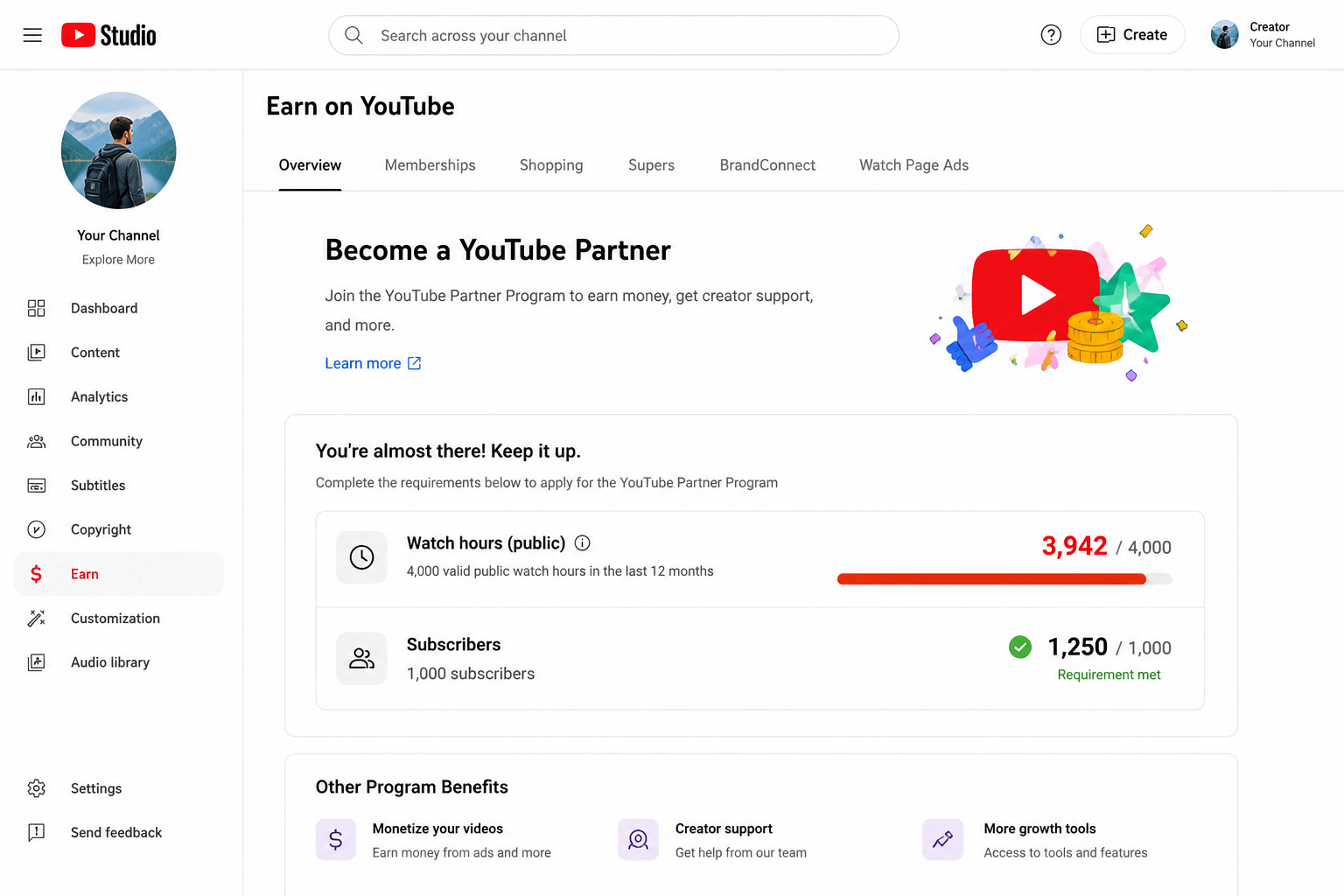
How to Reach 4,000 Watch Hours Fast (Without Shady Tricks) — 2026 Guide
If you're a creator with 1,000 subscribers searching how to get 4000 watch hours, you're standing on the most important threshold in YouTube creator economics. Crossing it unlocks the YouTube Partner Program, AdSense revenue, channel memberships, and a permanent shift in how the algorithm treats your channel.
But the road from 1,000 watch hours to 4,000 trips up most creators — usually for one reason. They reach for shady shortcuts: view bots, watch-hour exchanges, fake retention services. YouTube catches all of these, and the penalties are severe. This guide walks you through the honest 2026 strategy instead — the one that actually works and doesn't risk your entire channel.
Quick Answer
To reach 4,000 watch hours fast in 2026, focus on six honest tactics: produce longer videos that justify their length, engineer retention curves to stay flat, build playlists that auto-continue, publish at your audience's exact peak window, refilm topics with proven retention, and use channel analytics to double down on what's working. Most creators hit the threshold 30–50% faster this way.
What Counts as Watch Hours for YouTube Monetization in 2026?
YouTube counts public, non-Shorts watch time toward the 4,000-hour threshold required for the YouTube Partner Program. Private videos, unlisted videos, deleted videos, and Shorts under 60 seconds don't count toward this specific requirement — Shorts have a separate 10-million-view threshold.
The 4,000 hours must accumulate within a rolling 365-day window, which means watch hours from videos older than a year stop counting. Every long-form upload needs to stay relevant, or you need fresh content keeping the count climbing.
Why Are 4,000 Watch Hours Hard to Reach for Most Creators?
4,000 watch hours is hard because short-form content dominates upload habits while long-form watch time is what monetization actually requires. A 15-minute video at 50% retention is worth roughly 7.5 minutes per view — a creator needs around 32,000 such views to reach 4,000 hours. Most channels can't generate that volume in twelve months unless every upload is engineered for length and depth.
The honest fix isn't more uploads. It's smarter uploads. Each video should be designed from the start to maximize watch time per impression, not just CTR.
What's the Honest Strategy to Reach 4,000 Watch Hours Faster?
1. Produce Longer Videos That Justify Their Length
Watch time scales with video length, but only if the content earns it. A 20-minute video at 40% retention delivers 8 minutes per view; a 10-minute video at 60% retention delivers only 6. The math favors length when retention holds.
Aim for the 12-to-20-minute sweet spot for most niches in 2026 — long enough to compound watch hours, short enough that retention doesn't collapse. The trap to avoid: padding for length. Viewers detect filler immediately, and retention drops the moment they sense it.
2. Engineer the Retention Curve to Stay Flat
The retention curve shows what percentage of viewers are still watching at each second. A flat curve means viewers are staying; a steep drop means they're leaving.
Use pattern interrupts every 60–90 seconds — a visual change, a question, a new angle, a quick story. Open every section with a hook the viewer needs to resolve, and never summarize what you're about to say (it gives viewers permission to leave). The flatter your retention curve, the more watch time you bank per view.
3. Build Playlists That Auto-Continue Between Videos
Playlists are the single most underused watch-time multiplier on YouTube. When viewers finish a video inside a playlist, the next one starts automatically — and YouTube counts the entire session as watch time. A well-structured playlist can convert 10 minutes per viewer into 30 or 40 minutes.
Group your videos into 5-to-10-video playlists with logical progressions: beginner-to-advanced, problem-to-solution, or related-topic clusters. Put your strongest opener at the front; it carries the load, and the playlist banks the watch hours from there.
4. Publish at Your Audience's Exact Peak Window
YouTube tests every upload on subscribers first; weak first-hour engagement caps how widely the algorithm distributes the video. Generic "post at 3 PM Tuesday" advice misses the point — what matters is when YOUR specific subscribers are logged in and scrolling.
Use the YouSEO Best Time to Post on YouTube tool to surface your audience's exact peak window. Publishing in your densest 30-minute block typically lifts first-hour views by 40–60%, which compounds into significantly more watch hours per upload over the following 30 days.
5. Refilm Topics That Already Hit Retention Milestones
The fastest way to bank watch hours isn't a new topic — it's a better version of one that already worked. Identify your top three videos by absolute watch time (not views) and refilm each as a deeper, longer, more comprehensive version. Same hook, same promise, more substance.
The algorithm already trusts your channel to deliver on these topics, so the refilms get faster initial distribution. Most creators triple watch hours on the refilm because the audience appetite for the topic is already proven.
To find your next high-potential topic before filming, use YouSEO Trending YouTube Video Ideas — it shows what's gaining traction in your niche right now, so you can combine a proven format with a topic that already has built-in demand.
6. Fix Your SEO Before Every Upload
Most creators treat SEO as an afterthought — they write a title, add a few tags, and hit publish. That's leaving watch hours on the table.
Run every video through the YouSEO YouTube Video SEO Checker before it goes live. It audits your title, description, and tags against what's actually ranking in your niche, then surfaces exactly what to fix. Better SEO means more impressions, more clicks, and more watch time compounding over the weeks after upload — not just on day one.
Why CTR Still Matters Even When You're Chasing Watch Hours
It's tempting to focus exclusively on retention once you're in watch-hour mode — but CTR is what fills the top of the funnel. A video with 3% CTR needs roughly twice as many impressions to deliver the same views as a video with 6% CTR. Fewer views means fewer watch hours, regardless of how strong your retention is.
The YouSEO YouTube Video Thumbnail Maker is built specifically to close this gap. It helps you create high-contrast, scroll-stopping thumbnails designed to drive clicks — without needing a design background. Pair a strong thumbnail with a well-optimized title and you compound watch hours from both ends: more viewers arriving, and more of them staying.
How Long Does It Take to Reach 4,000 YouTube Watch Hours?
Most channels that follow this strategy reach 4,000 watch hours within 4 to 10 months of crossing the 1,000-subscriber milestone — significantly faster than the 12-to-18 months most creators take without one.
The timeline depends on niche, average video length, and audience appetite. Long-form niches like education, tech reviews, finance, and gaming tutorials reach the threshold fastest because their natural format favors longer videos. Short-burst niches like comedy or motivation often struggle because viewers expect 3-to-5-minute videos — if that's your niche, build playlists aggressively to compensate.
How Should Creators Close to the Threshold vs. Just Starting Approach This Differently?
For creators close to the threshold (2,500–3,500 watch hours)
The fastest path here is playlist construction. Group your existing top-performing videos into 5-to-7-video playlists organized by progression or theme. Pin the strongest playlist on your channel homepage. Then refilm your highest-watch-time video as a deeper version and add it to the relevant playlist.
This combination — auto-continuing playlists plus one new high-watch-time upload — typically delivers the final 1,000–1,500 hours within 6–8 weeks.
For creators just starting the monetization push (0–1,500 watch hours)
Focus on getting your average video length above 12 minutes and your retention above 45%. Don't worry about playlists or refilms yet — you don't have enough proven content to leverage them. Every upload should be designed from the start to maximize watch time: long enough to compound, structured enough to hold retention.
Once you have 8–10 uploads showing strong watch-time signals, switch to playlist-and-refilm mode for the final push to 4,000.
What Tactics Will Get You Disqualified From YouTube Monetization?
YouTube actively detects and disqualifies channels that use any of these methods to inflate watch hours:
View bots or watch-time bot services. YouTube's spam detection catches these within days. Channel termination is common.
Watch-hour exchanges or sub-for-sub schemes. Engagement from accounts that don't actually watch sends contradictory signals — the algorithm reads it as artificial.
Misleading thumbnails or titles. Clickbait that drops retention below 30% triggers algorithmic review and can disqualify monetization.
The cost of getting caught is permanent. The legitimate strategies above work faster anyway.
Frequently Asked Questions About Reaching 4,000 Watch Hours
How many videos do I need to reach 4,000 watch hours?
The answer depends entirely on average video length and retention. A creator publishing 15-minute videos at 50% retention needs roughly 32,000 views to hit 4,000 hours. Channels with longer videos and higher retention can reach the threshold in significantly fewer uploads.
Do YouTube Shorts count toward the 4,000 watch hours?
No. Shorts under 60 seconds don't count toward the 4,000-hour long-form requirement. Shorts have a separate 10-million-view monetization threshold. If long-form revenue is your goal, treat Shorts as a discovery funnel only — not a watch-hour strategy.
Can I reach 4,000 watch hours in 30 days?
Reaching 4,000 watch hours in 30 days is extremely rare and usually requires a single video that goes viral with very high retention. Most channels need 4 to 10 months. Promises of 30-day monetization are nearly always paired with shady tactics that risk channel termination.
Do watch hours from before the past 365 days still count?
No. The 4,000 watch hours must accumulate within a rolling 365-day window. Watch hours from videos older than a year stop counting toward this requirement, though those videos can still earn AdSense revenue once you're monetized.
Does playing my own videos on repeat add to watch hours?
No. YouTube identifies the account watching and excludes views from the channel owner, suspected duplicate IPs, and non-engaged sessions. Watch time from these sources does not count toward the 4,000-hour threshold and can trigger spam flags on your account.
How Do You Put Your Watch-Hour Strategy Into Action This Week?
The threshold isn't a wall — it's a process. Twelve uploads engineered for length and retention will get most creators across the line. You don't need shady tricks; you need to publish smarter videos and read your analytics weekly.
Start here: find your next video topic with Trending YouTube Video Ideas, build a thumbnail that earns the click with the Thumbnail Maker, run your SEO through the Video SEO Checker, and time your upload with Best Time to Post on YouTube. Each tool closes a different gap — together, they put your next upload on the fast track to 4,000.