
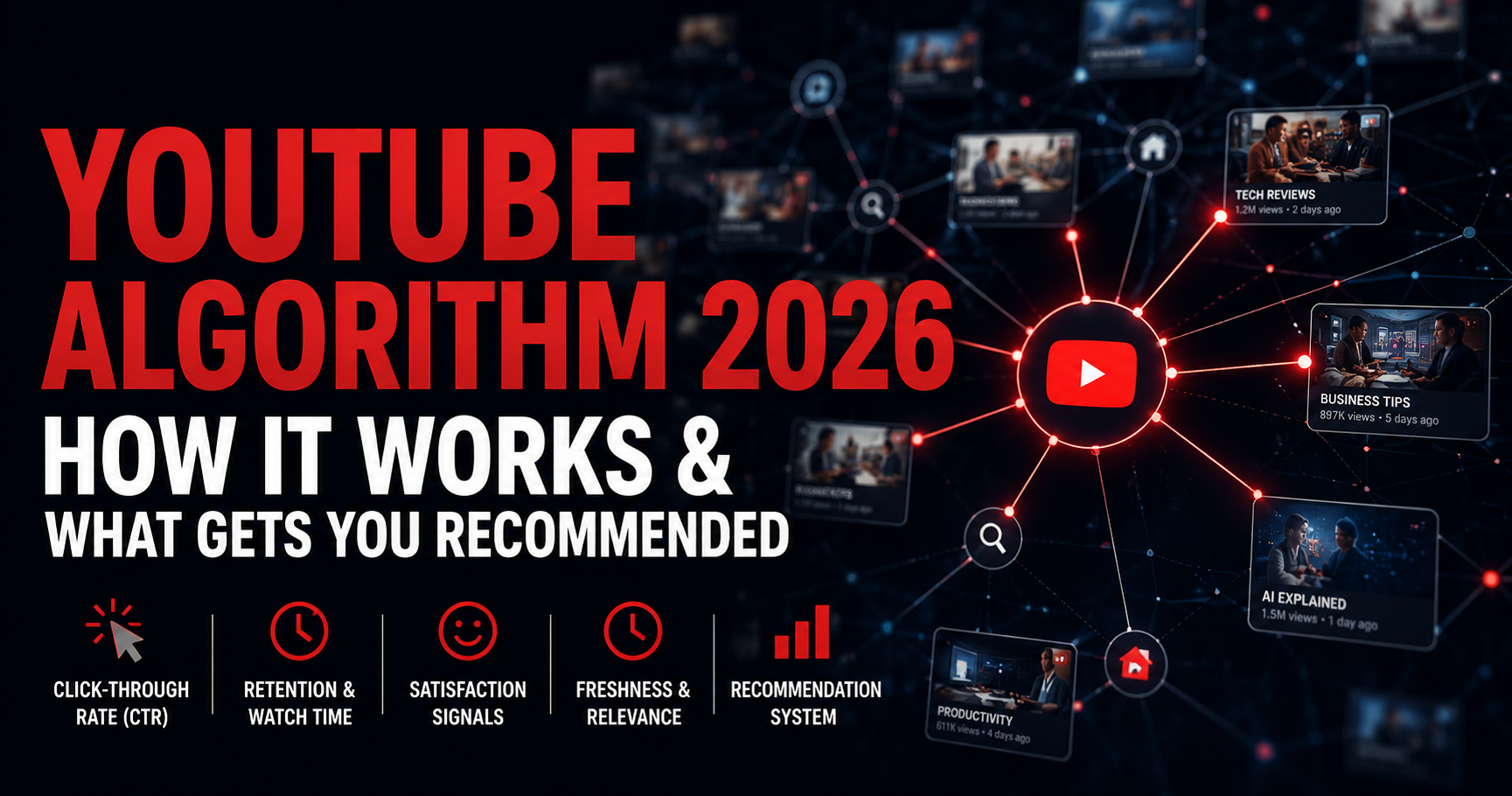
How the YouTube Algorithm Actually Works in 2026
Few topics on YouTube generate more bad advice than how the YouTube algorithm works. Every creator forum, every "viral hack" thread, every YouTube guru has a theory. Most are wrong. Some are dangerously outdated.
The truth is simpler -— and more useful -— than the mythology around it. The algorithm isn't trying to bury your videos. It's trying to match content with the viewers most likely to enjoy it. Once you understand the actual signals it reads and the surfaces it serves, working with it becomes a structural process, not a guessing game.
Quick Answer
The YouTube algorithm is a set of recommendation systems that match videos with viewers most likely to watch and enjoy them. It rewards five signals: click-through rate, average view duration, total watch time, viewer satisfaction (likes, shares, surveys), and freshness. Strong performance in the first 24-48 hours determines how widely a video gets distributed.
Why Does the YouTube Algorithm Feel Like a Black Box?
The algorithm feels opaque because most creators experience it through outcomes, not mechanics. A video flops; another inexplicably takes off. Without visibility into why, creators default to mythology -— pretending tags matter, that subscriber count gates discoverdiscovery, that a perfect upload minute exists. YouTube actually publishes much of how its systems work through creator-academy materials and engineering blogs. The mystery isn't the algorithm itself. It's that creators rarely read official documentation and instead absorb folklore from other creators repeating each other.
What Is the YouTube Algorithm? (Hint: It's Several Systems Working Together)
There isn't one algorithm. There are several distinct recommendation systems, each tuned for a different surface where viewers find content. Understanding which surface your video earns impressions on is the first step to growing reach intentionally:
- Home feed: personalized recommendations based on viewing history, subscriptions, and watch patterns. Rewards channels with strong historical retention.
- Suggested videos: the sidebar next to playing videos. Rewards thematic similarity, retention, and viewer co-engagement patterns.
- Search: keyword-driven results matching query intent. The most controllable surface -— covered in detail in our companion guide on YouTube SEO: how to rank your videos higher in search & suggested.
- Shorts feed: vertical content distribution based on real-time engagement velocity and audio-trend signals.
- Notifications: subscriber alerts triggered when uploads cross channel-specific velocity thresholds.
What Signals Does the YouTube Algorithm Use to Rank Videos?
Across all five surfaces, the algorithm reads the same five signals -— weighted differently per surface. Master these and your videos travel further everywhere the algorithm recommends them.
Click-through rate (CTR)
CTR is the percentage of viewers who click your thumbnail after seeing it. It's the algorithm's first test -— if no one clicks, no one watches, regardless of how good the video is. The niche median sits between 4-5%; channels consistently above 6% get exponentially wider distribution. CTR depends on your thumbnail-title combo earning the click against ten competing videos in the impression feed.
Average view duration and retention
Once a viewer clicks, retention takes over. Average view duration measures how long viewers actually watch; retention curves show where they leave. The algorithm reads retention as content satisfaction -— strong retention means the video delivered. Channels averaging 50%+ view duration earn far wider reach than those below 40%. Track your retention shape across uploads inside YouSEO Channel Analytics to spot patterns.
Total watch time
Watch time is CTR × average view duration × view count. It's the cumulative signal that drives long-term channel reach. A video with 10,000 views and 8 minutes of average watch time tells the algorithm more than a video with 100,000 views and 2 minutes. Total watch time, not view count, is what triggers wider distribution to new audiences.
Satisfaction signals
Beyond watch behavior, the algorithm reads explicit signals: likes, shares, comments, and post-video surveys. Surveys are particularly important -— YouTube periodically asks viewers to rate videos out of five stars. These responses directly weighweight future recommendations. Channels with high satisfaction scores earn lasting algorithmic favor; channels with high CTR but low satisfaction get short-term spikes followed by suppression.
Freshness
YouTube weights freshness differently by surface. News and trend content gets recency-boosted distribution for 24-72 hours; evergreen content earns slower but compounding distribution. Search rewards relevance over freshness. Suggested and Home weight a balance of both. Knowing which surface your content targets determines whether you should chase recency or build for the long tail.
How Do You Work With the YouTube Algorithm Instead of Against It?
The honest answer: make videos that are both clickable and satisfying. Most creators optimize one or the other -— they either over-engineer clickbait that tanks retention, or make content so dense the thumbnail can't earn a click. The algorithm rewards both. A clickable video earns impressions; a satisfying video keeps them. Together, they generate the watch time and satisfaction signals that trigger wider distribution. Concretely: spend equal effort on thumbnail-title pairing as on opening hook and pacing. Track CTR and average view duration as paired metrics -— high CTR with low duration means you've baited viewers; high duration with low CTR means your packaging isn't earning impressions.
Why Do the First 24-48 Hours After Upload Matter So Much?
The first 24-48 hours determine 70-80% of a video's lifetime distribution. YouTube uses this window as the primary test: it serves the video to a small subscriber pool, measures CTR, retention, and satisfaction, then decides how aggressively to widen distribution to non-subscribers. Get the early signals right and the video keeps earning impressions for months. Get them wrong and the algorithm caps distribution permanently.
This is why posting time matters -— not because there's a magical optimal minute, but because subscribers need to be online to engage during that test window. Use YouSEO Best Time to Post to find your audience's actual peak window and time uploads 30-60 minutes before it.
What Are the Biggest YouTube Algorithm Myths to Stop Believing?
Three myths kill more channels than any algorithm change ever could:
- "Tags drive ranking." They don't -— in 2026, tags have minor categorization value and zero major ranking impact. Spend 30 seconds on tags, not 30 minutes.
- "Subscriber count gategates discovery." It doesn't. The algorithm tests every upload on a small audience pool regardless of channel size. A 200-subscriber channel and a 200,000-subscriber channel face the same first-test mechanics.
- "There's a perfect posting time everyone should use." There isn't. The right time depends on when your specific audience is online, not a generic chart. Generic timing advice is the most overrated tactic in YouTube growth.
How Should New and Established Creators Approach the Algorithm Differently?
For new creators trying to get discovered
Beginners should obsess over CTR and retention, in that order. Without CTR you have no impressions; without retention you can't keep them. Don't worry about Browse or Home feed distribution until your Search and Suggested performance proves the content fundamentals work. Your first 20 uploads exist to teach you what your audience responds to. Track CTR and average view duration on each one. Patterns emerge by upload 10.
For established creators trying to scale reach
Established channels should diversify across surfaces. If your channel earns 80%+ from Search, you're vulnerable to a single algorithm shift. Build content for Home (highly retained series), Suggested (thematic clusters), and Shorts (lateral discovery) in parallel. Identify which new keyword adjacencies align with your channel's existing authority -— these are easiest to rank for and expand reach without rebuilding from zero.
Frequently Asked Questions About the YouTube Algorithm
How does the YouTube algorithm decide which videos to recommend?
The algorithm matches videos with viewers most likely to watch and enjoy them. It reads click-through rate, watch time, retention, satisfaction signals (likes, shares, surveys), and freshness, then recommends videos with strong combinations of these signals on Home, Suggested, Search, and Shorts.
Does the YouTube algorithm favor longer videos?
Not directly. It favors videos with high total watch time, which longer videos can achieve only if retention holds. A 25-minute video at 40% retention earns less watch time than an 8-minute video at 85% retention. Match length to content needs, not algorithm assumptions.
How often does the YouTube algorithm change?
YouTube ships continuous adjustments and several major recommendation system updates per year. Core signals -— CTR, retention, satisfaction -— stay consistent. What shifts is weighting and surface behavior. Building for the core signals beats chasing each rumored update.
Can you trick the YouTube algorithm with hacks?
No. Engagement bait, view-buying, and view-loop schemes get detected fast and tank long-term distribution. The algorithm's job is to match content with satisfied viewers; tricks that inflate signals without satisfying viewers ultimately hurt the channels using them.
Why does my video get fewer views than expected?
Most underperformance traces back to CTR or retention failure in the first 24-48 hours, not algorithm suppression. Open YouTube Studio retention curves and impressions data -— the diagnostic answer is almost always there.
How Do You Put This Algorithm Understanding Into Action This Week?
The algorithm isn't your opponent. It's the matchmaker between your content and the viewers most likely to value it. The work isn't tricking it -— it's giving it the signals it's already designed to read.
Track the signals the algorithm rewards -— CTR, retention, watch time -— with Channel Analytics. Earn impressions in search and suggested by targeting the right terms with the Keyword Research tool. Build early momentum in the critical first 24-48 hours by posting when your audience is online -— use Best Time to Post. Try YouSEO free today.