
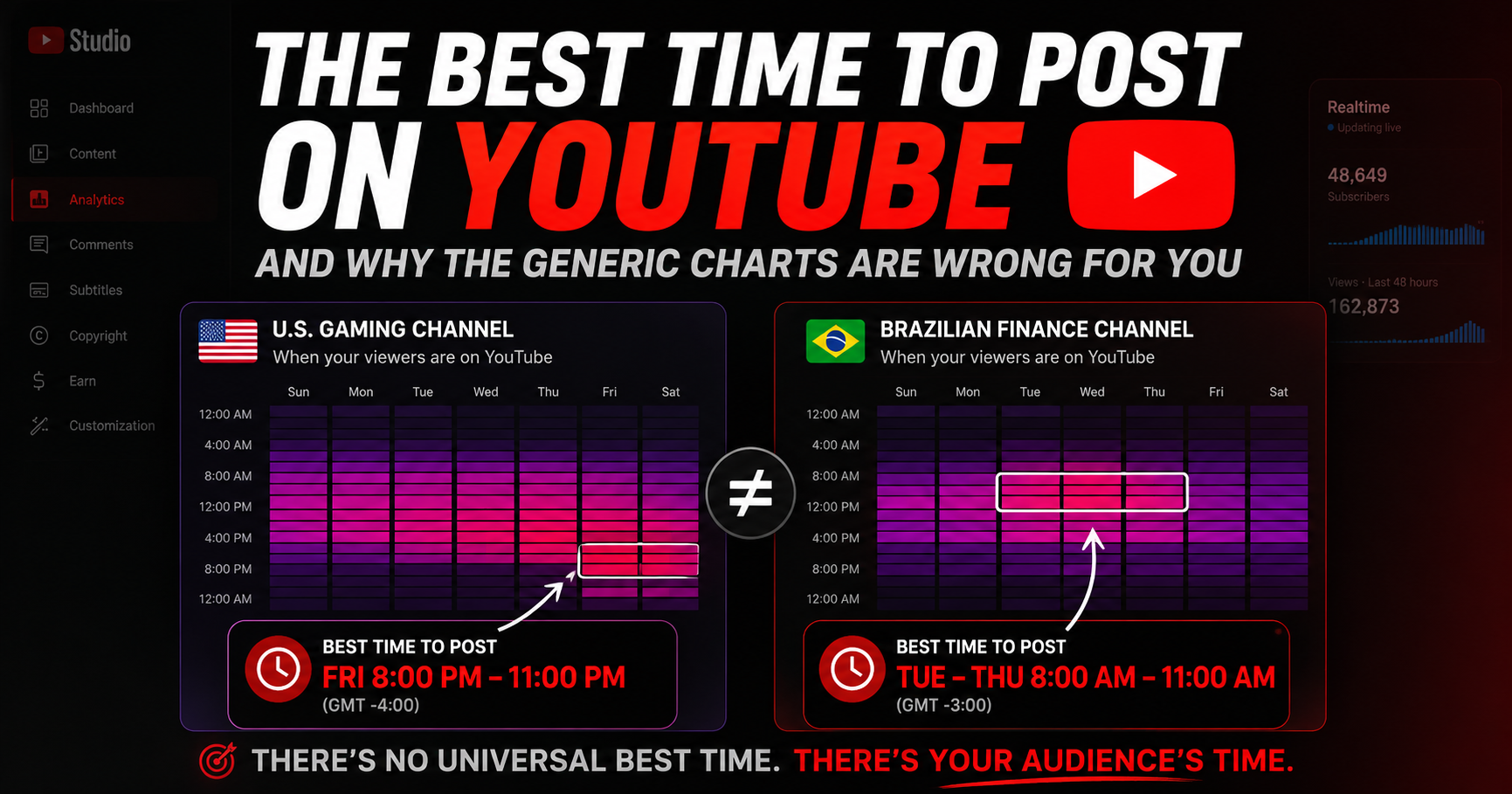
The Best Time to Post on YouTube - and Why the Generic Charts Are Wrong for You
Search the best time to post on YouTube and you'll find dozens of charts: Thursday at 3 PM, Saturday at 11 AM, Tuesday morning. They all disagree, they all claim to be data-driven, and most of them are wrong for your channel.
The reason is simple: those charts average across every niche, every audience, every time zone, and every channel size. They report a statistical middle that fits almost nobody specifically. The real best time to post on YouTube depends on data only you have access to. This guide walks you through finding it.
Quick Answer
The best time to post on YouTube is when your specific subscribers are most likely to be online and engaged - typically 30-60 minutes before your audience activity heatmap peaks in YouTube Studio. Generic charts ignore your niche, time zone, and audience profile, which is why most creators following them still see weak reach.
Why Are Generic "Best Time to Post" Charts Wrong for Most Channels?
Generic best-time-to-post charts fail because they treat YouTube as if it had one audience and one time zone. It doesn't. A finance creator in São Paulo has a completely different peak window than a gaming creator in Tokyo or a beauty creator in London. The chart that averages all of them produces a number that fits none of them.
Worse, those charts can't see your audience. They don't know whether your subscribers skew nighttime gamers, lunch-break vloggers, or weekend hobbyists. The first-hour engagement window - when YouTube tests your upload on subscribers - collapses if you publish when your specific audience isn't online to engage.
What Actually Determines Your Best Time to Post on YouTube?
Your best time is determined by four channel-specific signals, in this order of importance: where your viewers live, when your specific audience is on YouTube, your niche's viewing habits, and your first-hour engagement velocity. Each is observable from your own analytics - and once you find the right window, you can publish in it every week and compound the timing advantage.
Where your viewers live and watch
YouTube Studio shows your top viewing countries under Analytics → Audience. If 60% of your subscribers are in North America and 30% in Western Europe, your peak window is the overlap between U.S. evening and European late-evening - roughly 7-9 PM EST. Channels with heavy single-country audiences have narrower peak windows. Multi-country audiences often do best targeting whichever region has the largest subscriber concentration.
When your specific audience is on YouTube
Studio's "When your viewers are on YouTube" report shows you the exact hours your subscribers are active, plotted in your own time zone. This is the single most accurate signal you have. The peak block is usually a 2-3 hour window each day - and publishing 30-60 minutes before that peak gives subscribers time to see the notification, engage, and trigger YouTube's first-hour distribution test in your favor.
Your niche's specific viewing habits
Different niches have radically different viewing patterns. Educational content gets heavy weekday morning views during commute hours. Gaming and entertainment skew nighttime. Family content peaks on weekends. Beauty and fashion get afternoon and early-evening views. If your niche has a known viewing pattern, weigh your audience heatmap by that pattern - your channel is likely closer to the niche average than to YouTube's overall average.
First-hour engagement velocity
YouTube tests every new upload on a small subscriber pool in the first hour. If that test fails - low CTR, low retention, low engagement - the algorithm stops widening distribution. Timing matters as much for engagement velocity as for raw audience presence. Publishing 30-60 minutes before peak gives subscribers time to be notified, click through, and watch with intent. Off-peak posting gets weaker engagement signals even when the video is great.
How Do You Find Your Channel's Best Time to Post Step by Step?
Here's the workflow:
1. Open YouTube Studio → Analytics → Audience. Note your top three viewer countries.
2. Scroll to "When your viewers are on YouTube." Identify the densest 2-3 hour window each day.
3. Pick the time 30-60 minutes before that peak. That's your candidate posting window.
4. Compare against your top-performing videos. Open Studio → Content → sort by view count. Note publish times of your top five videos. Pattern-match against your candidate window.
5. Test for four weeks. Publish at the candidate time for one month, holding everything else constant. Track impressions, CTR, and first-hour views.
For a deeper picture of which analytics signals matter most, see our companion guide on how to read your YouTube analytics to find what's working. Or use YouSEO Channel Analytics to surface per-hour performance patterns across uploads - more clearly than YouTube Studio shows them on individual videos.
Is the Best Time to Post Different for YouTube Shorts vs. Long-Form?
Yes - significantly. Long-form YouTube benefits most from publishing 30-60 minutes before your audience peak so subscribers have time to be notified and engage during the first-hour test. Shorts work differently. The Shorts feed serves vertical content based on real-time engagement, so Shorts perform best when posted right at your audience's peak block, not before it. Long-form: 30 minutes before peak. Shorts: right at peak. If you publish both formats, track timing data separately for each - generic blanket times almost never work the same way across formats.
How Should New and Established Creators Approach Timing Differently?
For new creators with limited audience data
If you have fewer than 100 subscribers, your audience heatmap is statistically unreliable. Default to the niche pattern - educational mid-morning, gaming evenings, family content weekends - and post consistently in that window for your first 10-15 uploads. Once you have 500+ subscribers and a populated heatmap, switch to your actual audience data. Until then, the niche pattern beats personal data because there isn't enough personal data to read.
For established creators with rich audience analytics
Channels with 1,000+ subscribers and 6+ months of history have enough data to make timing precise. Audit your top 10 videos by view count and identify the publish-time cluster. If 7 of 10 are published in the same 90-minute window, that's your optimal block - even if it differs from YouTube Studio's heatmap recommendation. Real publish-time data from your top performers usually beats theoretical activity-window data when they disagree.
How Do Two Channels in the Same Niche End Up With Completely Different Best Times?
Consider two channels in the same broad category:
- A finance education channel with 70% U.S. audience peaks at 7-9 AM EST on weekdays - commute and pre-work viewing. Best post time: 6:30-7:00 AM EST, Tuesday or Wednesday. Use YouSEO Best Time to Post to confirm your specific data.
- A gaming highlights channel with a global audience and heavy U.S./LATAM viewership peaks at 8-11 PM EST. Best post time: 7:30 PM EST, Friday or Saturday.
Both channels would find the generic chart's recommendation ("Thursday 3 PM") catastrophic for their reach. The lesson: there's no universal best time. There's only the best time for your channel.
Frequently Asked Questions About the Best Time to Post on YouTube
What's the actual best time to post on YouTube in 2026?
There's no universal answer. The best time depends on where your viewers live, when your audience is online, and your niche's viewing habits. Use YouTube Studio's "When your viewers are on YouTube" report and publish 30-60 minutes before the daily peak block.
Does posting at the same time every week actually matter?
Yes. Consistency trains both your audience and the algorithm. Audiences learn when new content arrives; the algorithm reads steady cadence as reliability. A consistent good time beats an occasional perfect time by a significant margin.
Are weekends really better than weekdays for YouTube?
It depends on your niche. Family, lifestyle, and gaming content often peak on weekends. Educational, business, and tech content often peak on weekday mornings. Don't follow the "weekends are better" rule blindly - check your own audience data.
How long should I test before changing my posting time again?
Test any new posting time for at least four weeks before drawing conclusions. Single uploads at a new time generate too much noise. After four weeks, compare impressions, CTR, and first-hour views against your previous schedule.
Does the best time to post matter for established channels?
It matters slightly less because established channels have built-in subscriber notification reach. But first-hour engagement still affects algorithmic recommendations, so timing optimization continues to pay off - usually 15-25% more impressions per upload at peak vs. off-peak.
How Do You Put Your Best-Time Strategy Into Action This Week?
The honest answer to "what's the best time to post on YouTube?" is "the time when YOUR audience is online." Forget the generic charts. Open your own analytics, find your peak window, publish 30-60 minutes before it, and commit to that schedule for at least a quarter.
The fastest way to find your channel's actual best posting time is to run your audience data through YouSEO Best Time to Post - built on your channel's specific subscriber activity, not a generic chart. Pair it with Channel Analytics to track the impressions lifted over time. Try YouSEO free today.